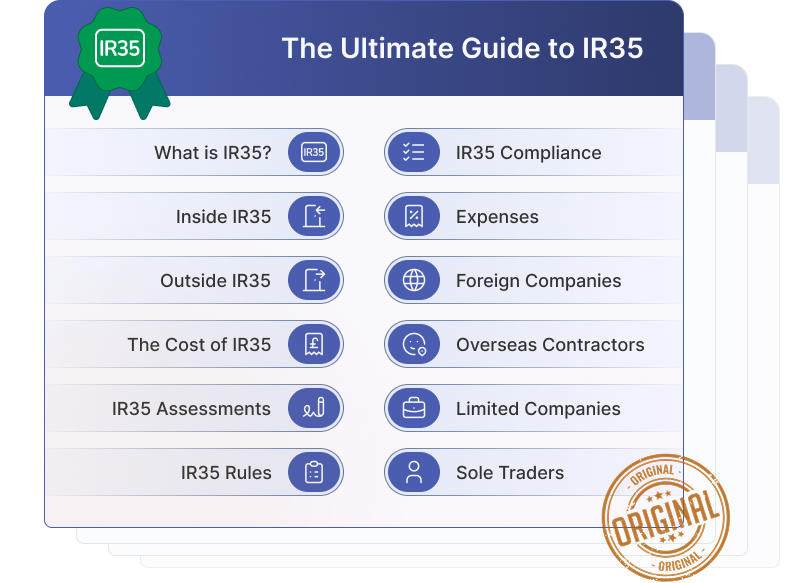
The Ultimate Guide to IR35
Navigating the complexities of UK tax legislation can be daunting, especially for contractors. Among the key regulations is IR35, a term that has sparked much discussion and confusion since its introduction. But what does IR35 mean, and how might it affect you?
Our guide breaks down everything you need to know about IR35, from understanding whether you’re inside or outside, to exploring how status is determined. We’ll tackle common questions like “What is IR35?” and “How does it work?” while shedding light on its implications for contractors.
IR35 is a nuanced area of tax law, and it’s important to approach it with care. While this guide provides a comprehensive overview, always seek professional advice if you have specific concerns. Whether you’re new to contracting or looking for clarity on your obligations, this guide is designed to empower you with the knowledge to navigate IR35 confidently.
What is IR35?
IR35, or the “off-payroll working rules,” is UK tax legislation designed to determine whether a contractor is genuinely self-employed or operating as a “disguised employee”. It applies when a contractor works through a limited company but their working arrangements resemble those of an employee.
Key takeaways
- Introduced by HMRC in 2000, IR35 tackles ‘disguised employment’ where contractors benefit from tax efficiency while working like employees.
- IR35 determines whether a contractor’s arrangement reflects employment (‘Inside IR35’) or self-employment (‘Outside IR35’).
- Supervision, substitution rights, and mutuality of obligation are critical in deciding if a contract is caught by the IR35 rules.
- IR35 applies to individual contracts via a Status Determination Statement (SDS), usually prepared by the end client.
- UK-resident contractors must consider IR35 regardless of client location.
- Misclassification as ‘Outside IR35’ can lead to additional tax payments, penalties, and interest.
Background to IR35
Permanent employees and contractors are treated differently under UK law. If a contractor provides services through their own limited company, they may take some of their pay in dividends instead of taxable salary. They can also offset several business expenses against Corporation Tax and pay less in National Insurance Contributions. This lower tax burden reflects the more significant financial risk of being self-employed.
HMRC introduced IR35 (or the ‘off-payroll working rules’) in 2000 to tackle ‘disguised’ employment. When a contractor is a ‘disguised’ employee, they take advantage of the tax efficiency of working through a limited company despite being treated and working as though they are an employee by the end client.
HMRC views these disguised employees as avoiding tax by taking advantage of the reward with none of the corresponding risks. The benefit for employers is that they don’t have to pay employers’ National Insurance Contributions or give the contractors employee benefits. The benefit for contractors is that they can pay themselves through their limited company to minimise their tax burden.
What does ‘IR35’ mean?
‘IR35’ was the reference given to the press release which first announced the off-payroll working rules, it was the Inland Revenue’s (IR) 35th (35) press release. IR35 is used to determine whether a contract points towards employment or self-employment, combating tax avoidance by closing loopholes and ensuring contractors working the same way as permanent employees pay the same taxes.
If a contract is ‘Inside IR35’, it points towards employment. The working arrangements are similar to those of a permanent employee, so HMRC imposes broadly the same Income Tax and National Insurance liabilities. Working Inside IR35 is usually done via an umbrella company that handles the administrative burden of paying the correct taxes.
If a contract is ‘Outside IR35’, it points towards self-employment, and you can enjoy the tax efficiency that self-employment brings (as well as all the associated risks). Working Outside IR35 is usually done via a personal service company (‘PSC’). A PSC is a limited company set up by a contractor to provide their services; they are usually the sole shareholder and company director.
How does IR35 work?
IR35 applies on a contract-by-contract basis; it does not apply once to your entire company. For each contract, the relevant ‘decision-maker’ (usually the end client) prepares a Status Determination Assessment (‘SDS’) . The SDS looks at the engagement contract’s wording and the contractor’s day-to-day working practices and decides whether IR35 applies.
Three key factors are considered when assessing a contractor’s IR35 status:
Supervision, Direction and Control
Does the contractor maintain autonomy over what work must be done, when it has to be done, and where it has to be done? If not, this points to an employee-employer relationship.
Substitution
Does the contractor have the right to provide a qualified replacement in their place should they be absent for any reason? If not, this is an indicator that the contract is Inside IR35.
Mutuality of Obligations
Mutuality of obligations exists when an employer has a legal duty to provide work, and the employee has a legal duty to perform said work. It is a vital part of a traditional employee/employer relationship.
HMRC offers detailed guidance notes and an online tool to help decision-makers determine whether IR35 is relevant. Third parties also specialise in performing these assessments and providing insurance against a potentially incorrect determination.
Who does IR35 apply to?
Any contractor that is a UK resident for tax purposes has the potential to be impacted by IR35, although the party responsible for performing the SDS can vary. This is a point that often confuses contractors. They mistakenly believe that if a potential client is overseas, then IR35 doesn’t apply. Instead, they become responsible for the SDS, decide whether they are Inside IR35, and hold the liability should this decision be wrong.

If you are a contractor paying tax in the UK, you need to consider IR35.
Inside IR35
If a contract is found to be ‘Inside IR35’ it means the working arrangements are similar to that of an employee, as opposed to that of a self-employed individual. As a result, the contractor must pay the same taxes as an employee (Income Tax and National Insurance), usually via an umbrella company.
Key takeaways
- Working Inside IR35 means HMRC treats you as an employee for tax purposes, subjecting you to PAYE Income Tax and National Insurance like a permanent employee.
- Contractors Inside IR35 cannot use the tax-efficient salary and dividend structure available to those operating Outside IR35.
- Most clients prefer contractors to work via intermediaries, such as umbrella companies, to avoid direct payroll responsibilities.
Implications of being Inside IR35
Working Inside IR35 means that you have been caught by the IR35 rules, and HMRC regards the service you provide to be one of employment. You are considered an employee for tax purposes rather than a self-employed individual running their own business.
If you work Inside IR35, you are subject to the same Income Tax and National Insurance Contributions as a permanent employee. You cannot make use of the salary and dividend structure in the same way you can while working Outside IR35 via a limited company. Instead, you are paid via PAYE.
Paying a contractor via PAYE requires a fee-payer to run payroll. Most clients do not want to take contractors onto their payroll directly; instead, they prefer to engage contractors via an intermediary such as an umbrella company.
If you are a permanent employee considering contracting for the first time, accepting an Inside IR35 contract is more straightforward than working Outside IR35 via a limited company. You do not need to incorporate a limited company, hire an accountant, or submit a self-assessment tax return.
Once you have chosen an umbrella company, all you need to do is submit your timesheets. The umbrella company will handle the administrative tasks of running payroll and paying the relevant taxes to HMRC.
The situation is more complicated if you are an existing contractor considering switching from working Outside IR35 to working Inside IR35, as you need to decide what to do with your limited company. Do you keep it going, make it dormant, or close it completely?
Trading while Inside IR35
Once a project is found to be Inside IR35, an intermediary must be chosen. Although umbrella companies are by far the most common trading solution, they are not the only option available to contractors:

Umbrella Company
An umbrella company acts as an intermediary between the contractor and the end client, charging a small margin to handle the administrative task of running PAYE. The contractor submits a timesheet, and the umbrella company invoices the client.
Once the client pays the invoice, the umbrella company deducts Income Tax, National Insurance, and employer costs (employer’s National Insurance, apprenticeship levy, and umbrella margin). The net amount is then paid directly into the contractor’s personal bank account.

Agency PAYE
With agency PAYE, the contractor is enrolled into the recruitment agency’s PAYE system and effectively becomes their employee for the duration of the contract. The agency pays the contractor a fixed rate while charging the client an uplifted amount to cover their fee and administrative costs.
The agency deducts Income Tax and National Insurance from the contractor’s rate and pays the net amount into their personal bank account. There are rarely additional costs to the contractor as the agency factors administrative and employer costs into what they charge the end client.
Although this may make it seem like Agency PAYE is better than operating through an umbrella company, a contractor’s net take home is usually the same. End clients should offer inflated rates for umbrella company contractors to reflect that they pay the employer’s costs directly. However, how accurately rates are inflated has been a point of contention since the IR35 rules emerged.

Limited Company
Most contractors are unaware that you can technically continue working through your limited company while working Inside IR35. In reality, very few contractors work this way as most end clients refuse to work with contractors on an Inside IR35 basis unless it is via an umbrella company or agency PAYE.

Fixed-Term Contracts
Contractors working on fixed-term contracts are employed directly by the end client for a specific period. As the contractor is an employee, there is no intermediary, and the IR35 rules do not apply.
By law, the employer treats the contractor the same way they treat other employees on a permanent basis. The contractor receives equal treatment to other employees for the contract duration. They have unfair dismissal and redundancy rights, receive the same pay, and pay the same taxes.
It’s worth noting that, although there are technically many options available to Inside IR35 contractors, recruitment agencies and end clients frequently specify that they will only accept contractors working through an umbrella company.
Outside IR35
Outside IR35 means a contractor is considered self-employed for tax purposes, allowing them to work through a limited company and benefit from tax efficiencies (such as the salary/dividend split). This classification reflects genuine business-to-business engagements, where contractors assume the financial risks and responsibilities of self-employment.
Key takeaways
- Being Outside IR35 means operating as a genuine business, typically through a limited company, with full control over revenues, profits, and tax-efficient income withdrawal.
- Contractors Outside IR35 are not subject to PAYE, receiving the entire fee amount from the end client.
- Operating Outside IR35 requires submitting a self-assessment tax return, and many contractors hire specialist accountants to handle the complexities of running a limited company.
- Most Outside IR35 contractors use a personal service company (PSC) for liability protection and financial benefits, separating personal and business assets.
Implications of being Outside IR35
Being ‘Outside IR35’ means that you are running a genuine business and, therefore, operating outside of the IR35 rules. As an Outside IR35 contractor, you are a limited company director, invoicing your client directly and using the company revenues and profits in a way that suits you, just like any other small business owner.
Financially speaking, working Outside IR35 means taxes are not deducted at source, and you are not subject to direct PAYE. Instead, the client pays the entire fee amount (plus VAT if applicable) to your limited company as revenue. This revenue is subject to Corporation Tax and a mixture of Income Tax and Dividend Tax, depending upon how it is withdrawn.
As you are not subject to PAYE, you must ensure you pay the right amount of tax by submitting a self-assessment tax return at the end of the year. Most contractors working Outside IR35 employ the services of a specialist contractor accountant, as the nuances of running a limited company can be tricky.
Trading while Outside IR35
Choosing a legal structure is one of the most important decisions Outside IR35 contractors must make. There are several options available:
Limited Company
Almost all Outside IR35 contractors choose to operate via a personal service company (PSC). A PSC is a limited company set up by a contractor to provide their services; they are usually the sole shareholder and company director. As a limited company is a distinct legal identity, the contractor’s personal assets are not at risk should the company face financial hardship.
Sole Trader
A sole trader is a self-employed individual who is the sole owner of their business. As a sole trader, there is no distinction between yourself and the business; you are considered the same entity. You have absolute control over how the business is run and are entitled to keep 100% of the profits. Although technically possible, Outside IR35 contractors rarely work as sole traders. Most end-hirers won’t work with them as there is a risk that the sole trader could seek to claim employment rights from the hirer (as is common in the construction industry).
From a contractor’s point of view, not only are there financial benefits involved with working through a limited company, but sole traders also face virtually unlimited liability. Their personal assets could be at risk in the face of litigious clients.
Umbrella Company
An Outside IR35 contractor can, in theory, decide to work through an umbrella company. As with an Inside IR35 contract, the umbrella company would invoice the client and then deduct all relevant taxes before paying the contractor net. In practice, this is rarely done as it removes any ability to distribute earnings tax-efficiently. The only time Outside IR35 contractors consider working through an umbrella company is if the contract is short or if they are considering moving to a permanent position. In these cases, they may not want the administrative burden of setting up and later closing down a limited company.
The Cost of IR35
Since IR35 was first introduced, contractors have tried to ensure they operate as a genuine business Outside IR35. Operating in this way ensures they can pay themselves a tax-efficient salary and dividend split. By doing so they minimise Income Tax exposure and both employer and employee National Insurance Contributions. But what happens to those contractors that are caught by the IR35 rules? What is the cost of IR35?
We’ve attempted to quantify the impact of IR35 by comparing various scenarios for two contractors, Jack and Jill. Both charge a daily rate of £500; however, Jack works Inside IR35 via an umbrella company, while Jill works Outside IR35 via a limited company. The following calculations use our Inside IR35 Calculator and Outside IR35 Calculator, assuming 230 working days and using the tax rates from 2024/2025.
Comparison of £500 per day
At a daily rate of £500, the financial outcomes for Jack and Jill differ significantly based on their IR35 status. Jack, who works Inside IR35 via an umbrella company, has annual taxable earnings of £106,705, pays £33,388 in taxes, and takes home £67,317 (£3,609 per month). Jill, working Outside IR35 via a limited company, has lower taxable earnings of £91,254 but only pays £16,956 in taxes and takes home £74,298 (£5,192 per month).
This results in Jill taking home almost £7,000 more per year than Jack, a 9% higher take-home. To match Jill’s take-home pay, Jack would need to charge a daily rate of £530, an 18% increase over his current rate. The cost of being caught by IR35 is clearly substantial.
Key drivers of the disparity
The primary reason for this disparity lies in the different types of taxes each contractor pays. Jack’s income is taxed at source through PAYE, resulting in Income Tax and employee National Insurance Contributions. On the other hand, Jill’s income is structured through her limited company, allowing her to pay Corporation Tax and Dividend Tax, which are generally lower than PAYE taxes.
Additionally, Jack faces a significant burden of employer National Insurance Contributions, paying £12,641 annually compared to Jill’s £473. This discrepancy highlights a common frustration with IR35: contractors classified as employees for tax purposes often bear the costs typically associated with employers.
Impact of changing daily rates
The financial disparity between Inside and Outside IR35 contractors varies with daily rates. At £300 per day, Jack’s annual take-home pay is £44,116 compared to Jill’s £51,899, a difference of 15%. At £700 per day, Jack takes home £95,772, while Jill’s take-home is £91,058, narrowing the gap to 6%.
Although the inequality appears to decrease the higher the daily rate charged, this isn’t beneficial. It simply reflects that the difference between the dividend and Income Tax rates reduces the more you earn. Higher earners pay higher tax rates on the income that falls into the respective bracket, so key takeout working Outside IR35 via a limited company is so attractive. It facilitates effective tax planning.
Impact of effective tax planning
The above calculations assume that Jill withdraws all cash from her limited company in the year it was earned and has no allowable expenses. While this above us to identify a general parallel between Inside IR35 and Outside IR35 take “home” rates, it does not reflect reality.
In truth, working Outside IR35 through a limited company allows Jill to choose how she withdraws her money from the business. She can select from several different strategies to minimise her tax liabilities effectively.
Allowable expenses reduce the Corporation Tax liability, delaying payment of a dividend to the following tax year reduces the amount captured by higher rate tax brackets, and leaving revenue in the company as retained earnings enables claiming Business Asset Disposal Relief (BADR) upon winding up.
BADR is the most effective way contractors can reduce their tax bill. BADR turns a dividend into a capital payment instead of paying the relevant Dividend Tax rate, contractors and investors see a reduced capital gains rate on qualifying disposals of 14%.
When considering tax planning, the disparity between Inside IR35 and outside IR3 take-home increases significantly. Take the £500 per day example above. If Jill decides to leave 25% of her net profit in the company as retained earnings, and can claim BADR upon closing the company.
This results in a total capital gain of £78,970: £61,266 from standard take-home, and £17,704 from BADR. That is an increase of £16,653 per year to Jack’s take-home, or 15%. To earn an equivalent take-home while working Inside IR35, Jack must charge a daily rate of £640, a 28% increase from what he currently earns.
Impact of pension contributions
As taxes are deducted at source for Inside IR35 contractors, pension contributions are the only tax planning tool available. Maximising pension contributions reduces tax liability, and increases total capital gained (this is different from take-home pay). This is a popular strategy for Outside IR35 contractors to make better use of their earnings.
In our example above, if Jack decides to contribute 50% of his relevant earnings to his SIPP via salary sacrifice, he would have a total capital gain of £93,915: £40,203 from standard take-home and £53,712 from pension contributions. This is a substantial improvement over the £67,317 take-home achieved with no pension contributions.
Summary
Every contractor’s working arrangements and earning profile differ, so identifying a single figure that can quantify the cost of being caught by IR35 is impossible. It can vary based on days worked, other sources of income, expenses, allowances, tax rates etc.
As such, there are some inherent limitations to the above calculations. For example, they do not consider the impact of allowable expenses Outside IR35 contractors can offset against Corporation Tax. Pension contributions are employed as well; neither contractor has the luxury to view this in-come in sense from a hypothetical tax reduction perspective, many contractors can’t afford to lock away such a high proportion of their income until they retire.
The same can be said about BADR. While it is a fantastic form of tax relief, it is only claimable once a company is wound down (i.e. closed). Until then, the money is stuck in the business and can’t be accessed. It also goes without saying that not everyone’s contracting career is going to a multi-year or multi-industry far tax years.
While the difference between Inside and Outside IR35 take-home pay can be substantial, depending on your daily rate, contracting length, and use of tax reliefs, the vast majority can go some way to reducing the deficit.
IR35 Assessments
IR35 assessments determine whether a contractor operates inside or outside the IR35 legislation. These evaluations examine factors like control, substitution, and mutuality of obligation to establish employment status. Accurate assessments are crucial for ensuring compliance and avoiding tax penalties for both contractors and hiring organisations.
Key takeaways
- IR35 must always be considered by UK tax residents working through intermediaries, with the responsibility for assessment varying by the client’s size, sector, and location.
- End clients or fee payers are responsible for IR35 assessments unless the client is a small private company or wholly overseas, in which case the contractor is responsible.
- The assessment reviews the contract and working practices for signs of “disguised employment”.
- The party conducting the assessment bears responsibility for any additional tax liabilities, interest, and penalties if the determination is incorrect.
- The CEST tool lacks reliability, with many users reporting unclear results and misinterpretations, making it unsuitable as the sole method for IR35 assessments.
When does IR35 apply?
If you are a UK resident for tax purposes and are considering working as a contractor through an intermediary (such as a limited company), IR35 must always be considered. The only variable is around whose responsibility it is to conduct the IR35 assessment.
This is an important point that often confuses new contractors who believe that working with small businesses or overseas clients exempts them from IR35. They are incorrect. Working with small companies or overseas clients means the contractor is responsible for the IR35 assessment and is liable should HMRC investigate and find it faulty.
Who is responsible for the IR35 assessment?
IR35 applies on a contract-by-contract basis. For each contract, the relevant decision-maker prepares a Status Determination Statement (SDS), which looks at the engagement contract’s wording and the contractor’s day-to-day working practices. The party responsible for preparing the SDS depends on the industry in which the client operates, the size of their business, and the location they’re based.
The responsibility for performing the SDS lies with the end client/fee payer if:
• The client is in the public sector; or
• The client is in the private sector and classified as a medium or large company; or
The responsibility for performing the SDS lies with the contractor if:
• The client is in the private sector and classified as a small company (i.e. does not meet the definition of medium or large); or
• The client is classified as ‘wholly overseas’ with no UK presence.
The decision-maker responsible for the SDS is also the party responsible for the additional tax liabilities, interest payments and penalties should the assessment be wrong.
How is IR35 status determined?
There is no ‘HMRC approved’ template for IR35 assessments. Instead, those responsible must review the contract and the day-to-day working realities against the IR35 rules. HMRC look at both when performing an IR35 investigation.
The responsibility for performing the IR35 assessment lies with the contractor only if you provide services to a private sector client defined as a small company under the Companies Act 2006 or a foreign business classed as ‘wholly overseas’. The end client/fee-payer is responsible for the assessment in all other situations.
Contractors that have to perform their own IR35 status determination should note that there is no specific assessment process. Instead, you need to consider the IR35 rules in conjunction with the written terms of your contract and the day-to-day working arrangements. When performing the assessment, it’s essential to remember that genuine Outside IR35 contracts are business-to-business relationships. The contract will likely be inside IR35 if you ‘look and feel’ like an ’employee’ in your day-to-day working arrangements even if the contract says you are not.
Given the potential costs of getting an assessment wrong, contractors who have to perform the review themselves should opt for professional help in the form of a contract review.
QDOS’ Full IR35 Contract Review service offers a concise assessment of your contract and working practices, providing a comprehensive report of the engagement’s IR35 status with a clause-by-clause analysis and straightforward suggestions for positive changes.
HMRC’s IR35 CEST tool
HMRC claims that their Check Employment Status for Tax (CEST) tool can help determine whether you are ‘inside’ or ‘Outside IR35’ for tax purposes. The tool provides HMRC’s view of a worker’s employment status based on the information provided, although using the CEST tool when making employment status decisions is not compulsory.
HMRC has pledged to ‘stand by the results of the CEST tool if the information entered is correct; however, contractors should be wary about using it. Data released by HMRC show that of more than 1 million, at least three assessment per year have been made for the tool since 2017 when it was launched, yet only 22 government bodies were fined after failing to correctly assess the employment status of their contractors, with two of the departments using CEST and Safe Harbour arrangements.
Relying on CEST alone isn’t a smart move due to its unreliable nature, and the issues don’t stop there. The tool is too simple and lacks the detail required to assess every contractor accurately. Many contractors find the tool confusing, especially if they are asked about topics that don’t apply to them, which makes the results difficult to trust. Even HMRC Litigation teams have said that CEST tool results are not always accepted in tax tribunals.
IR35 Rules
The IR35 rules are used to determine the status of a contract engagement by assessing whether the working arrangements resemble employment or self-employment. Factors include control over work performed, the right to engage a substitute, and mutuality of obligation (the legal obligation of an employer to provide work, and the worker to perform said work).
Key takeaways
- Supervision, Direction and Control: Contracts Outside IR35 should grant contractors autonomy over their work. Excessive oversight, instruction, or management suggests employment.
- Right of Substitution: A genuine right to provide a substitute for work indicates self-employment and strengthens an Outside IR35 determination.
- Mutuality of Obligations: A contract for services, not of service, means no obligation to offer or accept further work, supporting an Outside IR35 status.
- Working Practices: The day-to-day reality must match the contract, considering criteria like financial risk, exclusivity, and integration into the client’s business.
- A well-drafted contract is not enough to itself; you need to demonstrate that the clauses reflect the actual working practices.
The three key tests that determine IR35 status are set out in employment law and have evolved over the day-to-day working practices against a framework known as the ‘IR35 case’. Against these rules, the assessor must decide whether the engagement would be one of employment or self-employment if there was no limited company in between. Is the contractor running a genuine business, or are they operating as a disguised employee?
1. Supervision, direction and control
2. Substitution
3. Mutuality of obligation
Supervision, Direction and Control
Supervision, direction, and control focuses on the manner in which a contractor carries out their work. It concerns what has to be done, when and where it has to be done, and how it has to be done. If a contractor maintains autonomy over these things, it indicates self-employment. If dictated to them, it is suggestive of an employment relationship.
Supervision involves oversight. For this to apply, the contractor must be closely monitored while performing the requested tasks to ensure they are performed correctly.
Direction involves being made to perform the work in a specific way, dictated by detailed instructions, ongoing advice and coordination.
When considering supervision, direction and control, contractors should ask themselves:
• Does the contract state that the client can oversee my work and give guidance on how to complete it? Does anyone have the right to tell me how to do my job?
• Does the client exercise any control over how I perform my work, or am I providing services for my agreed job or working on different tasks as the client sees fit?
For a contract to fall Outside IR35, contractors should have freedom over how they complete their work. HMRC provides several fictional examples to help reviewers with their assessment.
Substitution
Genuine Outside IR35 contracts are business-to-business arrangements. In the engaged limited company should have the right to provide a qualified replacement to perform the role if unable to work. This is called a ‘substitution clause’ and it’s a strong indicator of being Outside IR35.
For the purposes of IR35, a substitute is a short-term resource used to cover the contractor during periods of holiday, illness, or other unexpected absence. A substitute does not necessarily have to be an employee of the limited company. It is perfectly acceptable to engage another contractor if they have an appropriate skill set.
Exercising the right to use a substitute is considered a ‘silver bullet’, breaking the chain of personal service. It is a strong indicator of self-employment and being Outside IR35. That said, HMRC do distinguish between genuine rights of substitution and ‘sham clauses’.
A right of substitution is only likely to exist where the client does not care from one day to the next for the duration of the contract who turns up to carry out the work, provided that whoever does so is suitably qualified and experienced.
When considering substitution, contractors should ask themselves:
• Does the contract contain a specific ‘right of substitution’ clause?
• Could I bring someone else in to complete the contract, or do I need to do the work yourself?
• Does your contract contain a prohibition from doing so?
For a contract to fall Outside IR35, a contractor should be able to provide a suitably qualified substitute to complete the work in their stead.
Mutuality of Obligation
Mutuality of obligation exists when an employer has a legal duty to provide work, and the employee has a legal duty to perform said work. It is essential in a traditional employer/employee relationship as it protects employees, guaranteeing their right to an agreed salary and employment benefits.
In a business-to-business relationship, such mutuality of obligation doesn’t exist; businesses are engaged to perform a specific task. For contractors, this means that once you’ve completed a project, you’re under no obligation to work on further tasks, and the client is not obligated to offer them.
Mutuality of obligation is incredibly ambiguous. HMRC state that without mutuality of obligation, “there can be no contract of any kind”. It exists in some form, even if someone is contracting Outside IR35. As such, HMRC’s CEST tool doesn’t explicitly consider mutuality of obligation.
When considering mutuality of obligation, contractors should ask themselves:
• Is there an obligation on the employer’s end to offer me work, and on my end to state that I can work for, the contract? Is likely one of employment and to Inside IR35.
• Can I work for other clients simultaneously, or is this restricted?
If the client is legally required to offer work, or the contractor is limited in who else they can work for, the contract is likely one of employment and so Inside IR35.
For a contract to fall Outside IR35, it should be a contract for services rather than a contract of service, outlining the obligations of both parties to ensure that there is no obligation for further work when the contract ends.
Working practices
Supervision, direction and control, right of substitution and mutuality of obligation are all contractual clauses reviewed during an IR35 determination. However, there is no point in having a watertight, ‘Outside IR35’ contract unless it mirrors the reality of the day-to-day working arrangements.
When performing an IR35 enquiry, HMRC reviews both the contract and the contractor’s working practices to establish if the assessment is correct. The contract must reflect the working practices – essentially, the clauses must be genuine.
HMRC may consider additional criteria when working out IR35 status:
-
• Equipment
HMRC often tries to argue that if the client provides equipment and you don’t use your own, you’re a disguised employee.
-
• Financial risk
Self-employed contractors usually take a degree of financial risk, like any other business, and there’s usually a requirement to have professional indemnity insurance.
-
• Financial risk
Self-employed contractors usually take a degree of financial risk, like any other business, and there’s usually a requirement to have professional indemnity insurance.
-
• Part of the organization
Does the contractor attend Christmas parties? Are they part of the company structure? If the contractor has a team reporting to them, it could indicate employment.
-
• Exclusivity
Does the contractor work for other clients? Typically, the self-employed can work for multiple clients at once.
-
• Genuine business
This determines whether the contractor runs their limited company as a business. For example, does it have a website?
It’s important to note that clauses in taxation, the above points are insufficient to indicate IR35paid employment.
Using your own IT equipment often isn’t practical; clients frequently insist that contractors work on their equipment. This scenario is often unavoidable, especially for IT contractors. It’s not an indicator of being Inside IR35. Instead, it is usually a prerequisite for ensuring security protocols and limiting access to secure data.
The same can be said for having a company website. If you are a contractor who sources most of their work via job boards and recruitment agencies, you may have no practical reason to have a company website. Building one for the express purpose of appearing Outside IR35 holds no sway should HMRC open an enquiry.
IR35 Compliance
IR35 compliance requires contractors to ensure their contracts and working practices align with the IR35 rules. Contract reviews, accurate status determinations, and proper documentation help demonstrate due care. Errors can lead to backdated taxes and penalties, so contractors are encouraged to use professional reviews and insurance for protection.
Key takeaways
- The IR35 investigation process includes a request for information, a review of contracts and working practices, and a final decision, with contractors having the right to appeal.
- Incorrect IR35 status determinations can result in backdated taxes, interest, and penalties, with severity depending on the nature of the error or misconduct.
- The party responsible for the original IR35 assessment, contractor or client, bears liability for additional taxes, penalties, and interest if deemed incorrect.
- Regular contract reviews and working practice assessments help demonstrate reasonable care and mitigate risks, reducing penalties in case of disputes.
- Insurance can cover the costs of an HMRC investigation, including representation, taxes, and penalties, offering contractors protection and peace of mind.
HMRC IR35 Investigations
HMRC carry out several thousand random inquiries annually; anyone can receive notice of an IR35 investigation. Contracts can be evaluated up to six years in the past to see where legislation should have applied.
Contractors can also trigger an IR35 enquiry due to exhibiting certain suspicious behaviours. HMRC monitors all businesses and individuals via their submissions (i.e. VAT Returns, Confirmation Statements, Company Accounts, Self-Assessment Tax Returns), using this data to refine their risk profiling and targeting strategies.
HMRC seeks to narrow those cases subject to investigation by considering a range of factors, including engagement patterns, the nature of the company, the sector of operation and financial irregularities. They prioritise individuals for review if they see any indication that the limited company is merely a vehicle of convenience instead of a genuine business.
HMRC’s systems are likely programmed to look for identifiers like an individual operating through a limited company who is the sole director, has a spouse as a shareholder, has changeable turnover, a fluctuating gross profit rate, minimal expenses and pays the minimum wage but significant dividends.
If you are operating as such, don’t fret, many legitimately Outside IR35 contractors operate this way. An investigation is unlikely to find you Inside IR35 if you have followed the correct review procedures.
IR35 investigation process
IR35 enquiries are lengthy, complex, and technical, often taking multiple years to conclude. Broadly, though, the investigation can be split into three main steps:
Request For Information
HMRC send a letter referring to the contractor referring to a ‘Check of Employer Records’. The letter requests specific information, such as income breakdowns, work contracts, and reasoning as to why IR35 does not apply to the business.
If you are going to contact a tax advisor or IR35 specialist, it should be at this stage of the process before you respond to the letter. If you respond with adequate evidence to show you’re not within IR35, HMRC will close the enquiry. If, after examining the written contracts, HMRC thinks that IR35 may apply, they’ll send another letter asking for a face-to-face meeting with you as the director of your company or as a member of your partnership.
By accepting HMRC’s invitation for a face-to-face meeting, the enquiry can usually be concluded more quickly as questions can be answered immediately. If you don’t accept HMRC’s invitation for a face-to-face meeting, HMRC will continue their enquiry by writing to you.
Review of Information
HMRC will review the information provided and the day-to-day working arrangements that are in place. They do not rely solely on the information you have provided; instead, they contact any parties they think might have relevant information.
During their review, HMRC assesses whether you are a disguised employee. They consider whether the engagement would be one of employment or self-employment in the absence of a service company.
HMRC’s Decision
Once HMRC concludes its review, a letter informing you of its decision will be issued. If they decide your records are accurate and you are indeed Outside IR35, nothing further happens.
If they decide your contract is disguised employment and should originally have been classified as Inside IR35, a determination is issued. The determination outlines any additional Income Tax, National Insurance owed, and any late payment interest and penalties. You have the right to appeal HMRC’s decision, a process that involves a review of the case by an independent tribunal.
You have the right to appeal HMRC’s decision, a process that involves a review of the case by an independent tribunal.
Consequences of getting IR35 wrong
Being investigated by HMRC does not automatically mean you are a disguised employee. If you take the investigation seriously, correctly determine yourself to be classified as ‘Outside IR35’, and have a valid argument (and ideally, contract review), HMRC may close the investigation without financial implications.
However, if HMRC determines your status assessment is wrong and you have incorrectly been working Outside IR35, a total Income Tax and National Insurance bill for backdated periods is passed. At the end of the investigation, an assessment will be raised for any PAYE due.
The severity of the penalty is based on the reason for the inaccurate determination. If HMRC deems the misclassification was due to:• Was unaware or careless but didn’t know the assessment was inaccurate, they can be liable for a penalty of 30% of the tax bill.
• Was deceptive and knew the contract was within IR35 but chose not to act, they can be liable for a penalty of 70% of the tax bill.
• Actively intended to conceal the employment status and purposely engaged in tax avoidance activities, they can be liable for a penalty of 100% of the tax bill.
The consequences of getting IR35 wrong can potentially be crippling. Legal fees, taxes, interest, and penalties can all follow an HMRC investigation. Although the recent reforms place responsibility on the fee payer in most circumstances, there is still a significant downside for contractors involved in an IR35 investigation.
Who is responsible?
The party responsible for paying the additional tax liabilities, late interest, and penalties is the same party responsible for performing the original Status Determination Assessment. This depends on the client’s industry, business size, and location, with further detail provided in our guide on IR35 Assessments.
In summary, the liability lies with you as a contractor if you provide services to a client in the private sector classed as a small company or provide services to a business classified as ‘wholly overseas’.How to maintain IR35 compliance
Beyond opting to move Inside IR35, there is nothing you can do that will eliminate the possibility of an HMRC investigation altogether. There is always the chance that you receive that dreaded letter. All you can do is ensure your contract and working practices are Outside IR35 and mitigate the potential costs of an investigation through insurance.
Many companies specialising in contractor tax legislation or insurance offer independent IR35 contract reviews. These contract reviews provide an assessment of both your contract and working practices.
Ranging from £50 to £150, depending on the complexity of the feedback provided, an IR35 contract review will give an expert opinion on whether the contract sits inside or Outside IR35.They aim to identify clauses where HMRC may find an issue and often provide a list of recommended changes. These proposed changes afford you the opportunity to restructure any contractual provisions or working practices that may not be IR35 compliant.
By proactively undertaking an IR35 contract review, you demonstrate to HMRC that you have taken ‘reasonable steps’ to ascertain that your status lies outside of IR35. HMRC look favourably on this, and it will potentially reduce any penalties owed in the unlikely event a ruling should go against you.
HMRC can open an IR35 enquiry at any time for any reason. These investigations can be lengthy and costly, and without the guidance of a tax legislation expert, they can be challenging to defend. Having adequate IR35 insurance is therefore critical to ensuring peace of mind.
IR35 insurance primarily protects contractors from the extreme costs that can follow an IR35 enquiry. Depending on the policy, IR35 insurance can cover everything from expert representation to any tax liabilities, interest and penalties owed at the end of the investigation.
Although IR35 insurance is not mandatory, many contractors prefer to take out a policy to ensure someone with experience is fighting their corner should the worst happen. Qdos are a specialist insurance provider that offers comprehensive IR35 contract assessments and tax enquiry insurance.
Expenses
Under IR35, contractors can only claim expenses if they are approved by the client and reimbursed on top of the agreed rate. The 5% general expense allowance is now limited to contracts with small private companies. Contractors Outside IR35 have more flexibility to claim business expenses via limited companies.
Key takeaways
- Contractors working Inside IR35 can only claim expenses if they are approved and reimbursed by the end client, similar to how permanent employees claim expenses.
- Travel and accommodation expenses can be reimbursed if they are for work-related purposes or temporary workplaces, but no relief is available for commuting to a permanent workplace.
- Tax relief on pension contributions is still available for contractors working Inside IR35
- The 5% general expense allowance is only available for contracts with small private sector companies meeting specific financial and employee criteria
- Contractors Outside IR35 can work through limited companies, claiming allowable business expenses to reduce taxable profits.
What expenses can be claimed while Inside IR35?
In 2016, legislation came into effect restricting what could be claimed by contractors working Inside IR35. While expenses can still be paid, they must be agreed with the end client and paid in addition to your standard contract rate. Unlike limited company contractors working Outside IR35, expenses cannot be offset against earnings.
The easiest way to think about IR35 expenses is to think of yourself as a permanent employee of the end client. If a permanent employee can seek reimbursement for an expense, it is likely you can as well. If they can’t, you can’t. All expense claims must be submitted, approved, and reimbursed on top of regular income.
With regards to what expenses are allowable while working Inside IR35:
Travel Expenses
Under the new provisions that came into effect in 2016, any travel and subsistence while working Inside IR35 will be treated as if the engager employed the contractor directly. No relief is given for home-to-work travel costs and associated subsistence.
Inside IR35, contractors can only seek reimbursement for travel and subsistence expenses if they relate to the performance of their duties or travel to a ‘temporary’ workplace. These expenses must be approved by the client and paid in addition to the standard contract rate.
No relief is available for ordinary commuting, which is travel between home (or a place that is not a workplace) and a ‘permanent workplace’. HMRC outline several criteria for identifying what constitutes a permanent workplace.
Accommodation Expenses
The 2016 changes to travel and subsistence allowances also impact accommodation expenses. Inside IR35 contractors can no longer claim costs such as hotels unless approved and reimbursed by the fee payer.
Pension Contributions
Contractors working Inside IR35 can continue to claim tax relief on pension contributions, regardless of whether they work in the public or private sector.
IR35 and the 5% rule
Prior to April 2021, contractors working Inside IR35 were entitled to claim a 5% general expense allowance. This 5% was a flat rate, calculated on the gross fees receivable, and was designed to cover administration costs such as insurance, working from home, accountancy and training.
Since April 2021, new rules have significantly curtailed who can claim the 5% allowance. For all public sector and most private sector contracts, the 5% allowance no longer exists. The only exception is if the contract sits within the private sector and the client is deemed a ‘small company’.
Outside IR35 expenses
Contracts that fall outside of the scope of IR35 allow contractors to work via limited companies, claiming all allowable expenses. As a limited company owner, business expenses reduce profits before tax. This, in turn, reduces the amount of Corporation Tax owed to HMRC. More allowable expenses mean less taxable profit and a lower tax liability.
For an expense claim to be ‘allowable’, it must be incurred ‘wholly and exclusively’ for the purposes of business. The terms’ wholly’ and ‘exclusively’ are designed to prohibit expenditure that serves a dual purpose, a business purpose, and a non-business purpose.
Foreign Companies
IR35 does apply to UK-based contractors working with foreign companies. If the client is wholly overseas without a UK presence, the contractor is responsible for determining the IR35 status and is liable for the additional tax and penalties should the HMRC investigate and find the assessment to be incorrect.
Key takeaways
- UK-based contractors working for overseas clients are still subject to IR35, regardless of the client’s location.
- Wholly overseas clients (without a UK presence) shift the responsibility for performing the status determination back to the contractor.
IR35 and overseas clients
International markets can provide lucrative opportunities for UK contractors willing to work with overseas clients. Historically, the jurisdiction of the end client had minimal impact on a contractor’s IR35 status, as a contractor’s UK tax obligations were their responsibility only. However, the changes to the IR35 rules in April 2021 mean that contractors are no longer responsible for determining their IR35 status. Most of the time, the responsibility now lies with the end client or agency that pays the contractor.
Many overseas clients are unaware of the UK’s IR35 legislation or are uninterested in the time-consuming process of providing a status determination assessment. HMRC have no jurisdiction over non-UK-based companies and cannot force compliance with the IR35 rules.
If you are a UK resident contractor working for an overseas client, then IR35 still applies. Just because you work for a foreign company outside the UK or are paid in a foreign currency does not mean you can ignore IR35. This confuses a lot of contractors who think IR35 no longer applies if their client is not based in the UK. This is incorrect.
IR35 and whether a contract is inside or outside relates to the contractor’s working practices; it has nothing to do with where the end client is located. The only potential difference is who performs the IR35 status determination assessment.
How this impacts UK contractors
The UK government sought to clarify the confusion around IR35 and foreign companies in the Finance Bill 2020. Organisations without a UK presence, considered ‘wholly overseas’, are removed from the IR35 responsibility chain.
Instead, where a client is wholly overseas, the pre-April 2021 rules will apply, and it will be up to the contractor themselves to determine IR35 status. The responsibility and, most importantly, the liability is returned to the contractor.
It is up to the contractor to evaluate their own IR35 status and, if they assess themselves as Inside IR35, make the relevant Income Tax and National Insurance payments. Should HMRC conduct an IR35 investigation, any additional tax and penalties arising from an incorrect assessment will be payable by the contractor.
Where a contractor has an end client based wholly overseas, the 2021 IR35 reforms will not apply, and the contractor must assess their IR35 status themselves.
What does ‘wholly overseas’ mean?
According to the gov.uk website, “an organisation is classed as overseas if it does not have a UK connection”. HMRC consider the definition of having ‘no UK connection’ to be where:
• The client does not have residency in the UK, and
• The client has no permanent establishment in the UK.
A permanent establishment in the UK is usually a branch or a local office. If the client is based overseas but has a branch or local office in the UK, no matter how small, the second test is not passed. The business is not wholly overseas, and they retain responsibility for determining IR35 status. They are liable for any additional taxes or penalties arising from an incorrect assessment, and HMRC will pursue any outstanding obligations through the UK establishment.
Overseas Contractors
IR35 does not apply when you have no liability to tax or National Insurance Contributions in the UK. Therefore, if you are a contractor based overseas and you qualify as a non-UK resident via the Statutory Residence Test, the IR35 legislation does not apply.
This does not mean that, as a UK-based contractor, your contract is automatically Inside IR35. All it means is that a Status Determination Assessment must be performed.
IR35 is irrelevant if you are a foreign contractor, but it must always be considered (regardless of the end client’s location) if you are a UK resident for tax purposes.
Limited Companies
Although it is unusual, contractors working Inside IR35 can operate through a limited company. Taxes are deducted at source by the fee-payer, paid into the limited company bank account, with the contractor taking the remaining funds as a tax-free salary. No additional taxes (Corporation Tax, Dividend Tax etc) are owed.
Key takeaways
- While not common practice, it is possible to work Inside IR35 via a limited company.
- Taxes are deducted at source by the fee payer, and remaining funds are paid to the limited company without further tax obligations. Contractors take tax-free salary from their limited company, avoiding double taxation.
- Many clients prefer contractors to use umbrella companies to avoid additional tax responsibilities and compliance risks.
- Contractors Inside IR35 can consider making their limited company dormant or closing it while awaiting Outside IR35 contracts.
Can I use my limited company while Inside IR35?
While it is not common practice, it is possible to continue working through a limited company if your current contract is determined to be Inside IR35. You don’t have to sign on with an umbrella company immediately. That said, although it is technically possible, most clients will refuse to hire contractors who work through a limited company while Inside IR35. They have preferred methods of engagement, usually via an umbrella.
Contractors that can work via their limited company while Inside IR35 will have taxes deducted at source by the fee payer (usually the client). The fee payer will allocate a tax code and make the relevant deductions for employers’ National Insurance, personal Income Tax and National Insurance.
The remaining amount is then paid to the limited company along with any VAT owed. As the fee payer has already deducted tax from the monies paid to the limited company, the contractor does not need to pay further personal taxes (income, NICs, or dividends), and the company does not need to pay any Corporation Tax on the received amount.
The contractor can take the total amount as a tax-free salary, transferring the money from the limited company directly to their personal bank account with no additional funds owed to HMRC. There is no double taxation. This video explains the process in detail.
Contractors working through a limited company while Inside IR35 should remember to check the amount of Income Tax deducted from the source by the fee payer. The fee payer only has sight of the current contract; they do not have knowledge of any other money the contractor may be earning. For example, a basic rate of 20% of Income Tax may be applied despite the contractor being a higher or additional rate taxpayer. If this occurs, the contractor must pay any outstanding tax through their self-assessment at the end of the year.
When is it viable?
Working Inside IR35 via a limited company may be viable if:
-
• End Clients Insists
Although most end clients insist on engaging Inside IR35 contractors via an umbrella company, some prefer the limited company option.
-
• Multiple Assignments
If you are working on multiple contracts, some caught by IR35 and some not, you may decide it’s easier to run them all through the limited company. Operating via a limited company retains the ability to accept contracts both inside and Outside IR35.
What are the limitations?
The inherent limitation of working via a limited company while Inside IR35 is that many clients will refuse to engage you. They do not want to adopt the additional responsibility of allocating a tax code and making relevant tax deductions. In addition, a lack of clarity regarding the IR35 rules means that clients insist on contractors using an umbrella company. Despite working through a limited company being a perfectly acceptable way to operate, clients do not want to risk being incorrect in their approach and exposing themselves to potential tax liabilities.
It’s also worth noting that, despite working through a limited company, if your contract is Inside IR35, you are still significantly restricted by the expenses you can claim.
What are the alternatives?
One option for a limited company contractor caught by the IR35 legislation is to make their company dormant. The company will have no trading activities, although it will still have ongoing (albeit minimal) filing obligations with both Companies House and HMRC. In this way, the limited company will continue to exist pending its future re-activation when Outside IR35 contract work becomes available.
If making the existing limited company dormant is not desired, the contractor may wish to consider closing it and taking advantage of the significant tax reliefs available.
Outside IR35 and limited companies
If your contract is Outside IR35, you operate as a genuine business-to-business relationship and can work through a limited company. You earn revenue, claim expenses, and can take advantage of efficient tax planning arrangements.
Sole Traders
IR35 does not apply to sole traders as they work as self-employed individuals, they do not operate via an intermediary. End clients tend to often avoid sole traders due to potential liability risks and employment rights claims, instead preferring contractors to operating through limited or umbrella companies.
Key takeaways
- IR35 does not apply to sole traders as they operate as self-employed individuals.
- Sole traders engaged directly by clients must undergo employment status tests similar to IR35.
- Contractors rarely work as sole traders because clients and agencies often refuse engagement, preferring limited or umbrella companies to minimise tax liabilities.
- Sole traders face unlimited personal liability, meaning they are personally responsible for business debts and may risk personal assets if the business fails.
What is a sole trader?
A sole trader is someone who owns 100% of an unincorporated business. As a sole trader, you and your business are legally one entity; you are not distinct in the way a limited company is from its owners.
Does IR35 apply to sole traders?
IR35 does not apply to sole traders as they operate as self-employed individuals. The IR35 legislation only applies to contractors working through intermediaries (such as a limited company). Although IR35 does not apply to Sole Traders, the issue of employment status for tax purposes remains.
The rules for determining employment status are similar to those for determining IR35 status. Which employment status tax legislation applies to you as a sole trader is determined by whether you’re a direct hire or working via an agency.
For sole traders engaged directly, the hiring organisation must consider traditional employment status tests. These tests are similar to IR35, covering substitution, mutuality of obligations, supervision, direction and control.
The end client decides your employment status, whether you are genuinely self-employed or operating as an employee. Like IR35, if a sole trader works for a client in a way that could be deemed disguised employment, the end client is at risk of being considered the employer. They would be liable for any unpaid Income Tax and National Insurance Contributions should the correct amount not be paid to HMRC, not the sole trader.
For sole traders engaged via an agency, the agency placing the contractor must consider the Onshore Intermediaries legislation. The agency is responsible for determining the contractor’s employment status.
The assessment criteria used are a simplified version of IR35, limited to whether the contractor works under supervision, direction or control. Any supervision, direction or control over the sole trader’s services could indicate disguised employment.
If this applies, the agency is responsible for deducting the relevant taxes and is liable for anything unpaid should the assessment be wrong. It is for this reason that most agencies are not prepared to engage with sole traders if they are not subject to PAYE; they are not willing to accept the additional liability.
Why don’t contractors work as sole traders?
Contractors rarely work as sole traders as they usually don’t have a choice; most agencies and clients will refuse to engage them. They will stipulate that they require a company (limited or umbrella) to act as an intermediary in the chain of services. They do this for two main reasons:
-
• Additional Tax
Contractors rarely work as sole traders as they usually don’t have a choice; most agencies and clients will refuse to engage them. They will stipulate that they require a company (limited or umbrella) to act as an intermediary in the chain of services. They do this for two main reasons:
-
• Employment Rights
As no intermediary (limited company etc) separates the contractor from the client, a contractor is one step closer to the employer. Therefore, there is a greater risk that an individual trading as a sole trader could look to claim employment rights from the client, a common occurrence in sectors such as construction.
In addition to the above, operating as a sole trader has downsides for the contractors themselves. For a sole trader, there is no distinction between business and individual. You hold personal responsibility for the businesses’ debts and may have to sell off personal assets to meet those debts should something go wrong.