
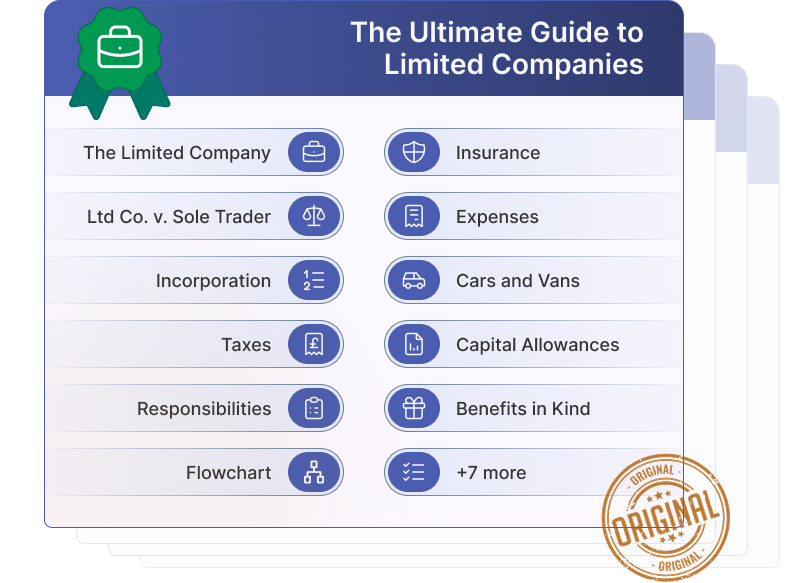
The Ultimate Guide to Limited Companies
As a contractor, one of the first decisions you’ll face is how to provide your services to clients. Should you register a limited company, work through an umbrella company, or operate as a sole trader? This choice significantly impacts your business, and the complexities often leave contractors unsure of the best approach. Once you’ve made your decision, what happens next?
This guide is designed to help you navigate everything related to limited companies; from deciding if this structure suits your needs to managing the ongoing administration involved. While we aim to provide clear and comprehensive information, it’s important to note that HMRC’s rules and legislation are complex. Treat this guide as a starting point and consult professional advice if anything is unclear.
This guide covers every stage of the process, from determining whether a limited company is the right choice for your business to understanding your responsibilities as a director. You will learn about registering with Companies House, appointing directors, setting up a business bank account, and meeting your compliance obligations. We also delve into the day-to-day administration required to run a limited company, including managing invoicing, bookkeeping, and staying aligned with HMRC regulations.
Whether you’re new to contracting or considering a switch in business structure, this guide provides the essential knowledge you need to make informed decisions and run a successful limited company.
What is a Limited Company?
A limited company is a business with a separate legal identity from its owners (shareholders) and managers (directors), limiting personal liability to the shareholders’ initial investment. Unlike sole traders, it can enter contracts, employ staff, and handle debts in its own name, protecting personal assets by offering distinct separation.
Key takeaways
A limited company is a distinct legal entity, separate from its owners and directors, providing protection for personal assets.
Limited companies offer tax efficiency, allowing owners to minimise their tax obligations through salary and dividends, while also claiming broader business expenses.
Limited companies enhance professional credibility, as their transparency and statutory obligations appeal to many clients.
Ownership is easily transferable and facilitates profit-sharing amongst shareholders.
Despite the benefits, limited companies require formal setup, ongoing administration, and accountancy fees, though these are often outweighed by financial advantages.
Contractors favour limited companies due to higher take-home pay, broader expense claims, and the ability to work on Outside IR35 contracts.
What does ‘limited’ company mean?
A limited company is a type of business with a distinct legal identity, separate from those who own it (the shareholders) and those appointed to manage it (the directors). It is a business structure that restricts the liability the company’s owners are exposed to.
The ‘limited’ refers to the legal protection that shelters the shareholders of a business against personal liability from the debts and liabilities of the business. As a limited company is a legally distinct entity, with finances separate from its shareholders, the shareholders’ assets are not at risk should the firm face financial difficulties or legal issues.
This is different from sole traders who do not have a legal distinction between the owner and the business itself. This is one of the key reasons limited companies are so popular with contractors. Unless there is fraud or serious wrongdoing, the amount you risk losing is restricted to the capital initially invested (the nominal value of shares held).
In the U.K., there are three types of limited company: (i) private company limited by shares, (ii) private company limited by guarantee, and (iii) public limited company.

Limited by Shares
A private company limited by shares is the most popular structure, designed for those wanting to run a for-profit business. It is the structure used by UK contractors. Ownership of the company is divided into shares and distributed between shareholders. Each shareholder’s percentage of ownership and voting rights depends on the value of the shares they own. Profits are distributed to shareholders in the form of dividends, paid out in relation to each individual’s percentage of ownership. If you own 50% of the shares, you receive 50% of the profits.

Limited by Guarantee
A private company limited by guarantee is commonly used by those wanting to set up a ‘not-for-profit’ organisation or charity. There are no shareholders in companies that are limited by guarantee. Instead, they are owned by ‘guarantors’ (also known as members). These guarantors agree to pay a fixed amount of money to the company if it cannot meet its financial obligations. Any surplus income is reinvested in the business rather than withdrawn as profit.

Public Limited
As in a private limited company, a public limited company is divided into shares. The difference is that a public limited company can offer their shares to the general public, whereas a private limited company cannot. This structure is rarely found in new businesses and never found in contractor-owned businesses. It’s more likely to be found in larger, more established companies which have reached a specific size and decided to ‘go public’.

A personal services company (‘PSC’) is simply another name for a private company limited by shares that has been set up by a contractor to provide their services to clients. They’re most often used in Outside IR35 arrangements, with the company acting as an intermediary between contractor and client. In most situations, the company is owned 100% by the contractor; they are the sole shareholder and director.
Advantages and disadvatages of a limited company
Limited companies are popular because they provide financial security, allow for the easy transfer of ownership, and often come with certain tax advantages, especially for growing businesses. However, they also require formal registration and are subject to more regulation and reporting than sole proprietorships or partnerships.
The most significant advantage of a limited company for most people is limited liability. However, there are many additional benefits to working through a limited company, including:
Limited Liability
ADVANTAGEA limited company is a legally distinct entity, providing a barrier between the shareholders’ personal assets and the company’s financial obligations. While working through a limited company, your responsibility for the company’s debt is restricted to the value of the shares you own in that company.
Unincorporated businesses, like sole traders, place no distinction between the business and the individual. All business finances and liabilities are the owner’s responsibility, and if the business were to suffer financial hardship, their personal assets are at risk.
Tax Efficiency
ADVANTAGEA limited company is a tax-efficient business structure. The business’s expenses (including wages) can be offset against Corporation Tax, while the owners can minimise their tax burden by paying themselves a specific combination of salary and dividends.
Owners of limited companies can also defer tax obligations by leaving surplus profit (known as ‘retained earnings’) in the business bank account and withdrawing it in a later tax year.
Professional Status
ADVANTAGEThe limited company structure creates a professional image. While the business activities and management practices may be the same as if you were a sole trader, your company will be held in higher regard. This added credibility is due to the statutory obligations to which limited companies are subject.
As a limited company director, you must ensure your business meets its reporting requirements. From confirming ownership details to filing annual accounts, everything a limited company does is closely recorded and available on public record via Companies House. This transparency is why most organisations prefer working with limited companies, and you could miss out on many lucrative opportunities if you don’t incorporate.
Transfer of Ownership
ADVANTAGEA limited company can easily transfer ownership of existing shares. As the company is a separate legal entity, all assets are registered under its own name. Transferring business ownership is far simpler than with a less formal structure.
Adding additional individuals (e.g., a spouse) to the shareholder register is also possible, thereby splitting the business’s profits. If done in line with the relevant HMRC legislation, transferring ownership this way efficiently reduces tax liabilities.
Very few disadvantages of the limited company structure could convince you not to incorporate your business.
Initial Setup
DISADVANTAGEAs a sole trader, setting up your business is free, as you are the business. There is no legally distinct entity. All you need to do is register for self-assessment. To incorporate a limited company, you must go through a structured process on the HMRC website and pay a one-off fee of £12.
While incorporating a limited company may seem daunting, you can hire an incorporation service to do it for you.
Ongoing Administration
DISADVANTAGESome individuals may find the additional reporting requirements that come with being a limited company director a burden. Maintaining appropriate records, submitting annual accounts and filing tax returns can be time-consuming.
Fortunately, limited company accountants can help ease this administrative burden.
Accountancy Fees
DISADVANTAGEWhile it is true that accountancy fees for a limited company can be more expensive than those for a sole trader, the disparity between the two is no longer as significant as it once was. It’s also worth remembering that accountancy fees are tax-deductible, reducing your Corporation Tax payments.
Contractors and limited companies
As a UK contractor, you may read the above and understand why, in principle, business owners usually decide to operate via limited companies. But why do contractors specifically prefer this type of business structure?
- Higher take-home pay
- For contractors working Outside IR35, providing services via a limited company is the most tax-efficient option. Limited company contractors are not subject to PAYE like permanent staff or umbrella company contractors. They can pay themselves a combination of salary and dividends that minimises Income Tax and National Insurance Contributions and maximises take-home pay.
- Ability to claim expenses
- As a limited company contractor, you can expense costs that are ‘wholly and exclusively’ for the purposes of running your business, from accountancy fees to IT equipment, phones, travel, and your home-office. These business expenses are offset against your company’s revenue, reducing the Corporation Tax you pay to HMRC.
In addition to the above, if you want to work on Outside IR35 contracts, you often have no choice but to provide your services via a limited company. Due to the rules around IR35 and sole traders, almost all agencies and end-hirers will refuse to work with sole traders.
Limited Company vs. Sole Trader
Deciding between a limited company or sole trader depends on your priorities. Limited companies offer limited liability, tax efficiency, and enhanced credibility but require more administration. Sole traders provide simplicity and direct control but involve personal liability for debts and higher taxes as profits grow. Choose based on your business goals and risk tolerance.
Key takeaways
A sole trader is a self-employed individual with full control over the business, no shareholders or directors, and personal liability for all debts and obligations.
Limited companies are separate legal entities, protecting shareholders’ personal assets from business debts and offering enhanced liability protection, especially in high-risk industries.
Sole traders face simpler administration with fewer regulatory requirements, while limited companies must adhere to strict compliance, including filing financial statements and maintaining corporate records.
Limited companies benefit from tax efficiency through corporate tax rates and dividend payments, whereas sole traders pay Income Tax on all profits, which can result in higher taxes as earnings grow.
Operating as a limited company enhances professional credibility and access to funding, while sole traders prioritise privacy and personal relationships to build reputation.
What is a sole trader?
A sole trader is a self-employed individual who is the sole owner of their business. There are no shareholders to pay dividends to or directors to help manage the day-to-day operations. As a sole trader, there is no distinction between yourself and the business; you are considered the same entity. You have absolute control over how the business is run and are entitled to keep 100% of the profits.
Due to the lack of a separate legal identity, you are personally responsible for the business’s financial obligations. If you do not pay your debts, the creditors you owe money to can take action against you directly.
There are several key differences between a sole trader and a limited company, these being:
- Legal Structure
- Taxation
- Administration
- Professional Image
- Profit Retention
Legal structure
[ Limited Company ]
A limited company is a distinct legal entity, separate from its owners (shareholders) and managers (directors). This separation provides a significant advantage in terms of liability. Shareholders’ personal assets are protected, as they are only responsible for the company’s debts up to the amount they invested in shares. This structure is particularly valuable for businesses with high risks, as it safeguards personal assets in the case of financial difficulties or legal claims.
[Sole Trader]
A sole trader is an individual who owns and operates the business on their own. There is no legal distinction between the owner and the business, meaning that all debts, legal obligations, and liabilities fall on the sole trader personally. While this provides simplicity, it also means that personal assets, such as a home or savings, could be at risk if the business incurs debt or faces a lawsuit.
Taxation
[ Limited Company ]
Limited companies are taxed on profits at the corporate tax rate, which is often lower than personal Income Tax rates, depending on jurisdiction. Additionally, limited company owners can pay themselves a salary and take dividends, allowing for more tax-efficient income planning. This flexibility often leads to lower overall tax rates, particularly in higher-earning companies.
[Sole Trader]
Sole traders are taxed as individuals, meaning that profits are subject to personal Income Tax. This can be beneficial in the early stages of a business when earnings are relatively low, as sole traders may benefit from lower Income Tax brackets. However, as profits grow, sole traders can face higher tax rates, as there are fewer opportunities for tax planning compared to limited companies.
Administration
[ Limited Company ]
Running a limited company requires compliance with a range of legal and administrative obligations, such as filing annual financial statements, maintaining a record of shareholders, and adhering to corporate governance standards. Directors must ensure that the company operates lawfully and that all records are up to date. These requirements can be time-consuming and may require an accountant’s assistance.
[Sole Trader]
The sole trader structure is far simpler in terms of paperwork and regulatory requirements. There’s no need to file annual financial statements, maintain corporate records, or comply with specific corporate governance rules. While basic bookkeeping is still necessary, the overall administrative burden is much lighter, allowing sole traders to focus more on running their business.
Professional Image
[ Limited Company ]
Operating as a limited company can enhance credibility and make a business appear more established and professional. This can be particularly beneficial when working with larger clients, suppliers, or investors who may view a limited company as more stable and reliable than a sole trader. Many clients and suppliers prefer to work with limited companies due to perceived security and stability.
[Sole Trader]
While sole traders can certainly be successful and credible, they may face some challenges when trying to win large contracts or deal with corporate clients who prioritise formal business structures. However, sole traders often build credibility through personal relationships and reputation, which can still be highly effective in certain industries.
Profit Retention
[ Limited Company ]
Limited companies can retain profits within the business, which can be reinvested in growth or used to build financial reserves. This allows for more flexibility in managing profits over time. Additionally, because ownership is divided into shares, limited companies are easier to sell, transfer, or pass on to new owners, making them more suitable for succession planning.
[Sole Trader]
For sole traders, all profits are treated as personal income, with fewer options to reinvest in the business tax-efficiently. If the sole trader wants to transfer ownership, it can be complicated, as the business is tied to the individual. Succession planning can be more difficult in this structure, as it relies heavily on the individual’s ongoing involvement.
Summary
A limited company is an excellent choice for business owners seeking limited liability, enhanced credibility, and access to funding. It’s also well-suited for businesses planning for long-term growth or succession, or those in high-risk industries. However, it requires a commitment to regulatory compliance and greater administrative effort.
A sole trader structure is ideal for those prioritising simplicity, privacy, and direct control. It’s often the best choice for freelancers, consultants, or small business owners just starting out, especially when the business involves minimal financial risk and doesn’t require external investors.
When deciding which business structure to use, you need to evaluate three key factors:
- Liability
- To what extent do you need to be protected from liability? Does your business lend itself to potential risk, and if so, can you personally afford it? A hairdresser, for example, is less likely to incur potential liability than a data security expert who works with a client’s confidential financial information.
- Future Needs
- A sole trader’s business will be legally dissolved upon the owner’s retirement or death, while a limited company will continue its operation. Shares can be distributed to existing or new shareholders depending upon the owner’s wishes. A self-employed tradesperson may not need to consider their business after retirement, but a construction company certainly would.
- Administration
- When considering whether to incorporate your business, you must ensure you have the time and ability to meet the stringent reporting requirements that HMRC requires. If you find these aspects challenging or are pressed for time, you can always hire an accountant; however, they often come with substantial costs.
Most contractors work through limited (or umbrella) companies as they don’t have a choice. Many clients and agencies refuse to work with sole traders due to issues caused by the tax legislation.
Incorporation
Incorporating a limited company in the UK is a quick and accessible process that can be completed entirely online through Companies House. While it’s generally simple, some steps may seem unclear to first-time business owners.
Key takeaways
Incorporation can be done online via the UK government’s Companies House website.
The process costs £50 and typically takes around 24 hours to complete.
The success rate is very high, with issues mainly arising from identity verification or name duplication.
Rather than covering every single step in the process, this guide highlights key points of potential confusion to ensure you can complete your registration smoothly and with confidence. Whether you’re a contractor, freelancer, or small business owner, this guide simplifies the path to setting up your limited company.
Initial admin
Start by visiting the government website, clicking “Register now,” and confirming you are starting a new application. Confirm that you can pay the fee via card or PayPal, which is an allowable business expense, or prepare to use Form IN01 if these options aren’t available. Indicate whether any directors or persons with significant control (PSCs) require secure register protection, which is typically unnecessary for most individuals.
Next, create a Government Gateway user ID by entering your email address, confirming it with a code, and providing your full name. Create a password and save your 12-digit user ID for future use. Sign into your account, select “Organisation” for account type, and set up additional security if prompted, such as receiving a text message with an access code. Finally, confirm the email address to be used for updates and application correspondence.
Select your relationship to the company
When incorporating a limited company, your relationship to the company could be one of the following:
- Company Director
- If you are setting up the company and will be responsible for running it, you are a director. Directors are legally responsible for the company’s operations, including filing accounts and tax returns. Most individuals reading this guide (including contractors) should select Company Director.
- Company Sectretary
- If appointed, a company secretary assists with administrative tasks and ensures compliance with legal and statutory requirements.
- Agent
- If you are helping set up the company but are not directly involved (e.g., acting as an agent or on behalf of someone else).
- Other
- Anyone else.
Most individuals reading this guide (including contractors) should select Company Director.
Will the company be limited by shares or limited by guarantee?
Whether a company will be limited by shares or limited by guarantee depends on its structure and purpose.
A company limited by shares has shareholders whose liability is limited to the amount unpaid on their shares. This is common for most businesses aiming to make a profit, such as private limited companies and public limited companies. Shareholders’ liability is limited to the amount they have agreed to pay for their shares, meaning they are not personally responsible for the company’s debts beyond that amount. This is the chosen structure for UK contractors.
A company limited by guarantee does not have shareholders but instead members who agree to contribute a fixed amount (the guarantee) in the event the company is wound up. This structure is often used for non-profit organisations, charities, or clubs where the members do not seek to share profits.
Will the company be limited by shares or limited by guarantee?
Whether a company will be limited by shares or limited by guarantee depends on its structure and purpose.
[By Shares]
A company limited by shares has shareholders whose liability is limited to the amount unpaid on their shares. This is common for most businesses aiming to make a profit, such as private limited companies and public limited companies. Shareholders’ liability is limited to the amount they have agreed to pay for their shares, meaning they are not personally responsible for the company’s debts beyond that amount.
[ By Guarantee ]
A company limited by guarantee does not have shareholders but instead members who agree to contribute a fixed amount (the guarantee) in the event the company is wound up. This structure is often used for non-profit organisations, charities, or clubs where the members do not seek to share profits.
A company limited by shares is the chosen structure for UK contractors.
Enter your company name
When choosing a company name for incorporating a limited company in the UK, there are several key considerations and legal requirements:
- Uniqueness
- The name must not be identical or too similar to an existing registered company name. Check this using the Companies House name availability tool.
- Legally Compliant
- The name must end with “Limited” or “Ltd” unless it is a specific type of organisation, such as a charity. Avoid offensive or sensitive words unless you have special permissions.
- No Trademark Infringement
- Ensure the name does not infringe on trademarks. You can check this through the Intellectual Property Office.
- Do Not Mislead
- Avoid names suggesting connections to government bodies, royalty, or other restricted terms unless permission is granted (e.g., “Royal,” “British,” “Bank”). You can check this webpage for a full list.
- Domain Check
- If you intend to create a company website, verify the availability of a matching domain name for your website to maintain brand consistency.
Many UK contractors simply use a variance on their surname as their limited company name, for example Smith IT Services Ltd.
Enter the company’s registered office address
A company’s registered office address is its official address. This address is used for receiving statutory correspondence, legal notices, and official communications from entities like Companies House and HMRC. It must be a physical location within the same jurisdiction where the company is registered and is publicly accessible. This means that it appears on the public register and is available for public inspection.
The registered office address does not have to be the company’s principal place of business. Many companies opt to use the address of an accountant, solicitor, or a registered office service provider to maintain privacy.
It’s important to note that the registered office address must be ‘appropriate,’ meaning that documents sent to this address should be expected to come to the attention of a person acting on behalf of the company, and any documents sent to that address can be recorded by an acknowledgement of delivery.
Additionally, as of March 2024, new regulations stipulate that a registered office address cannot be a PO Box and must meet the ‘appropriate’ criteria. If Companies House determines that a company’s registered office address is not appropriate, they may change it to a default address and potentially initiate the strike-off process if the company fails to provide a suitable address within the given timeframe.
As a contractor, if you don’t want your home address made public, you can use a registered office provider.
Select the company’s ‘principal place of business’.
A company’s principal place of business refers to the main location where its core activities are conducted and where key management decisions are made. It’s important to differentiate the principal place of business from the registered office.
The registered office is the official address recorded with government authorities, used for receiving legal documents and official correspondence. While the registered office can be a different location, the principal place of business is where the actual business operations and management occur.
For a contractor, the principal place of business will usually be their home address, where administrative task (such as bookkeeping) are performed and where decisions as to whether to accept a role are made.
This could be different to their registered office that could be at their accountant’s workplace, or the address of a registered office provider.
What will the company be doing?
SIC codes, or Standard Industrial Classification codes, are a system used to classify businesses by their primary activity. They provide a way of identifying the nature of a company’s operations, making it easier to categorise businesses within a particular industry or sector. These codes are used by government agencies, regulators, and statistical organisations to track and report on industry performance, as well as for regulatory and tax purposes.
The SIC system divides businesses into broad categories, which are further subdivided into more specific codes. For example, a company involved in manufacturing might fall under a general category for manufacturing, but its specific activity—like the production of electronic equipment—would be assigned a more detailed SIC code.
When registering a company, choosing the correct SIC code impacts a business’s eligibility for certain regulations, funding opportunities, and tax structures. It’s advisable to choose the most accurate code that represents the primary activity of your business.
For UK contractors, finding the ‘perfect’ SIC code is not necessary. If the code broadly reflects the services you provide, you shouldn’t have any issues. And remember, amending the code for your company after you’ve registered is a relatively simple process.
A full list of codes can be found here.
Set up the shareholders
When setting up the company’s shareholders you will be asked: (i) who the shareholders are, (ii) what type of shares they own, (iii) how many shares they own, and (iv) what value the shares hold.
Who are the shareholders?
You can add as many shareholders as you want, however for most contractors this will usually just be themselves. If you’d like to add a spouse, you can do so at this stage.
What types of shares do they own?
When registering a limited company in the UK, you may be asked if you want to use the “most common type of shares.” This question refers to the type of shares that your company will issue to its shareholders. The most common type of shares for a limited company in the UK are Ordinary Shares.
Ordinary shares represent the basic form of equity ownership in a company. When a company is incorporated, the owners (shareholders) are allocated shares in exchange for their capital investment. Ordinary shares come with certain rights and responsibilities, which include voting rights. Shareholders with ordinary shares usually have the right to vote on major company decisions at shareholder meetings, such as electing directors or approving business strategies.
Ordinary shareholders are also entitled to receive dividends if the company distributes profits, though these dividends are not guaranteed. They are typically paid out after any preferred shareholders have been compensated. Ordinary shareholders benefit from the company’s profits through potential dividend payouts and capital gains when the value of the company increases. However, in the event of liquidation, they are the last to receive any remaining assets after creditors and other preferred shareholders have been paid.
When you are asked whether you want to use the “most common type of shares,” it typically means that the company is being set up with Ordinary Shares, which are the most widely used and standard form of shares for UK limited companies. This is usually the preferred choice for most small businesses and contractors.
However, if your business has specific needs, such as raising capital or managing control, you might choose a different class of shares, but this will require additional planning and legal considerations.
How many shares do they own?
Every limited company in the UK has a share capital, which represents the ownership of the company. The company is divided into shares, and each share represents a unit of ownership in the business. The total value of shares issued represents the company’s initial capital.
A shareholder’s ownership in the company is determined by how many shares they own out of the total shares issued. For example, if the company issues 100 shares, and you are allocated 50 shares, you own 50% of the company. When forming the company, the initial shareholders decide how many shares they will each own. This decision will be based on agreements between the founders or investors regarding ownership percentages, funding contributions, and control of the company.
This question essentially asks you to decide and specify how many shares each shareholder owns when registering the company, determining their stake in the company, including voting rights, dividend entitlement, and overall ownership percentage. The number of shares you allocate to each shareholder should be based on your company’s share structure, which you’ll define when setting up the company.
If you are the only shareholder, you’ll own 100% of the company regardless of how many shares you choose. You only need to choose more than one share if you want to split ownership with others in future, and you can add more shares after the company is registered.

What value do the shares hold?
When registering a limited company in the UK, the question “Choose a value for each share” asks you to determine the nominal value (or face value) of each share issued by the company. This value is the amount assigned to each share when the company is created and represents the legal value of the share.
The nominal value is important because it helps define the company’s share capital, which is the total value of all the shares issued by the company. This value is not necessarily the price at which the shares will be bought or sold, but rather a legal designation used for registration purposes.
In the UK, the nominal value for shares is typically set at a low value, often £1 or less, but it can be any amount (subject to the company’s articles of association). For example, if you decide that each share has a nominal value of £1 and you issue 1,000 shares, your company’s share capital would be £1,000. The value you choose doesn’t impact the market value or the price at which shares might be sold to investors in the future, it is simply a legal number that is used when registering the company.
In practice, many small companies choose a nominal value of £1 per share because it simplifies calculations and keeps the share capital low. If you plan to issue a large number of shares to many people, you may choose a lower value, such as 0.01p (one penny) per share, which increases the flexibility in dividing the share capital.
In summary, choosing a value for each share determines the nominal value of the shares issued by the company and helps define the company’s share capital. This value is usually set at a low number, such as £1, and is a key part of the company’s incorporation process.
Most UK contractors will be the sole shareholder of their limited company. If this is the case, choosing 1 share at a nominal value of £1 is the simplest option.
Persons with significant control
When registering a limited company in the UK, the step “You’re about to set up the ‘Persons with Significant Control’ (PSC) over the company” refers to identifying and recording the individuals or entities that have significant control or influence over the company. This requirement is part of the UK government’s effort to increase transparency and prevent the misuse of corporate structures, such as for money laundering or tax evasion.
A PSC is an individual or entity that meets one or more of the following conditions:
- They may own more than 25% of the shares in the company, either directly or indirectly
- They could have more than 25% of the voting rights in the company.
- They may have the right to appoint or remove a majority of the company’s board of directors.
- An individual or entity can still be considered a PSC if they have significant influence or control over the company, even if they do not meet the 25% ownership or voting rights thresholds. This could include the ability to direct or influence the company’s activities in a way that is akin to control.
For most UK contractors, they will be the only PSC in their limited company.
Articles of Association
In the UK, when registering a limited company, the Articles of Association are a crucial legal document that outlines how the company operates. These articles define the rules and regulations for managing the company, such as the duties of directors, the rights of shareholders, and the procedures for making decisions. The government provides Model Articles of Association, which are standard rules applied by default if the company does not choose to adopt its own custom articles.
The Model Articles address key elements necessary for the operation of the company. They outline the company’s purpose, which is typically broad, allowing for any lawful business activity unless the articles specify otherwise. The Model Articles also establish the governance of the company, detailing the process for appointing, removing, and empowering directors, including how decisions are made and how many directors are needed.
These Model Articles are designed to suit most private limited companies, offering a simple and clear framework for governance. However, companies can choose to modify or replace them with their own custom articles if they have specific needs.
You might choose to replace the Model Articles of Association with custom articles if your company has specific needs that the standard rules do not address. While the Model Articles work for most businesses, custom articles are useful if you have unique shareholder arrangements, such as different classes of shares, or need more detailed governance provisions, like voting rights or share transfer restrictions. If you require tailored director provisions, like limiting the number of directors or decision-making processes, custom articles can help. For family-run businesses, custom articles provide more control over share ownership and transfers. Additionally, some industries may need specific rules around operations, such as shareholder loans or dividend distribution. If you plan to raise capital in the future, custom articles can define share issuance, investor rights, and control mechanisms.
For most UK contractors, the Model Articles of Association are fit for their needs.
Final stages
The final three stages of registering a limited company in the UK are as follows:
Confirmation of Company Details
After you’ve completed the necessary company details, including selecting the type of shares and the Persons with Significant Control (PSC), you’ll review all the information you’ve provided. This includes confirming the company name, registered office address, director details, shareholder details, share structure, and articles of association. Any errors should be corrected at this stage before proceeding.
Payment of Fees
Once all details have been confirmed, you will need to pay the registration fee. The fee depends on how you are registering the company (online or by post). For online registration, the fee is typically lower, while postal applications may cost more. The payment is made to Companies House, the UK’s official company registration body.
Company Incorporation
After completing the registration, you will receive confirmation of your submission, and a Certificate of Incorporation (typically within 24 hours if done online) which serves as official proof of your company’s formation. You’ll also be issued a Company Registration Number (CRN), which is your company’s unique identification number.
Bank Accounts
According to the Companies Act 2006, it is a legal requirement for a limited company to have a bank account. The bank account must be registered to the limited company; it can’t be registered under the name of its directors or shareholders. If you’re a contractor that has recently incorporated a limited company with Companies House, you must open a business bank account before you start trading and making/receiving payments.
As a limited company contractor, one of the ‘challenger’ banks like Starling, Monzo or Mettle is usually your best option. They offer free accounts, payment notifications, and integration with accounting tools like Xero. Mettle offers access to FreeAgent at no cost.
Taxes
Limited companies in the UK are subject to Corporation Tax, VAT, and PAYE. Corporation Tax is paid on profits, VAT applies to taxable turnover above £90,000, and PAYE covers Income Tax, National Insurance, and student loan repayments. Deadlines, registration requirements, and penalties vary, requiring careful compliance and record-keeping.
Key takeaways
Corporation Tax is paid on company profits, calculated by deducting allowable expenses, and taxed at rates of 19% or 25% depending on profit thresholds. Returns are due 12 months after the accounting period ends, with payment due 9 months and 1 day after the period’s end.
VAT is charged on most goods and services at 20% (standard rate), 5% (reduced rate), or 0% (zero rate). Registration is mandatory if taxable turnover exceeds £90,000, and businesses must file quarterly VAT returns.
Employers must deduct Income Tax, employee National Insurance, and other contributions like student loan repayments via PAYE. Employer NI contributions are also due, with payments typically made monthly.
PAYE submissions are made each payday via Real Time Information (RTI). VAT returns are due 1 month and 7 days after the VAT period ends. Corporation Tax payments are due before the return filing deadline.
Late registration, filing, or payment for Corporation Tax, VAT, or PAYE can lead to fines and interest charges. Failing to comply with Making Tax Digital (MTD) requirements for VAT or PAYE can also result in penalties.
Corporation Tax
Corporation Tax is a tax limited companies pay on their business profits. It is calculated by taking the business’s revenues, deducting allowable expenses (including salaries), and multiplying by the corporation tax rate.
Registration
You must register for Corporation Tax when incorporating a limited company or restarting a dormant business. Unlike VAT and PAYE, it is compulsory to register for Corporation Tax, and you must do so within three months of starting to trade.
Sign in to your business’ Government Gateway account to register for Corporation Tax. You’ll need to tell HMRC when you started to trade, as it will dictate your accounting period for Corporation Tax purposes. HMRC will then use this information to provide you with the deadline for paying Corporation Tax.
Calculation
Corporation Tax is calculated on taxable profits, which are determined by deducting allowable business expenses and capital allowances from your total income. The current Corporation Tax rate is 25% for profits exceeding £250,000, while profits below £50,000 are taxed at 19%. A marginal relief system applies to profits between these thresholds.
HMRC don’t automatically give you a bill for Corporation Tax; there are a few things you must do before you can pay the tax you owe. To know whether your business owes any Corporation Tax, you need to prepare a tax return (also known as form CT600). While completing the return yourself is possible, most companies get an accountant to do it.
A company tax return reports your company’s profits or losses for Corporation Tax, as well as your Corporation Tax bill. It involves submitting a financial report alongside supporting calculations. You must file even if your company has made a loss or you have no Corporation Tax to pay.
Filing and Payment Dates
Your Corporation Tax return must be submitted within 12 months of the end of the company’s accounting period (usually its financial year). Corporation Tax payment is due 9 months and 1 day after the end of your accounting period. For example, if your accounting period ends on 31 March, tax is due by 1 January the following year.
You’ll notice that the deadline for paying your Corporation Tax is before the deadline for filing your company tax return. Despite this, you’ll need to complete a tax return (even if it’s not immediately available) to determine how much tax is owed.
Points of Note
- Corporation Tax year vs. financial year:
- The Corporation Tax financial year runs from April 1 to March 31, but your company’s accounting period is based on its financial year-end. If your accounting period spans two Corporation Tax years, profits are apportioned between the years, and the applicable tax rate is applied to each part.
- Late registration penalties
- Failing to register for Corporation Tax within 3 months of starting trading can result in penalties. These penalties start at £100 but can increase significantly if not addressed promptly.
- Loss relief
- If your business makes a loss, you can carry it forward to offset against future profits, reducing your Corporation Tax bill.
Value Added Tax (VAT)
VAT is a consumption tax charged on most goods and services in the UK. Limited companies act as intermediaries, collecting VAT from customers on behalf of HMRC. VAT applies at each stage of the supply chain, but businesses can reclaim the VAT paid on their purchases, making it a tax primarily borne by the end consumer. The VAT system ensures transparency, with businesses acting as tax collectors rather than bearing the tax burden themselves.
There are three main VAT rates in the UK:
- Standard Rate (20%):
- This applies to most goods and services, including retail, consultancy, and professional services.
- Reduced Rate (5%):
- This applies to specific items such as domestic energy bills, child car seats, and some health products or services.
- Zero Rate (0%):
- While no VAT is charged on these items, they still need to be recorded in VAT returns. Examples include most food and drink, books, newspapers, and children’s clothing.
In addition to these rates, some items are exempt from VAT (e.g., insurance, financial services, and certain healthcare services) or are outside the scope of VAT (e.g., donations to charities). Understanding the distinction between these categories is critical for compliance and accurate record-keeping.
Registration
You must register for VAT if your total VAT taxable turnover for the last 12 months was over £90,000 (the VAT threshold) or you expect your turnover to go over £90,000 in the next 30 days. It’s important to note that turnover is different to taxable income. If you expect to be billing more than £90,000 over the coming year, you must register for VAT.
To register, you must create a VAT account on HMRC’s website and provide details such as your company’s turnover, business activities, and bank account information. Once registered, you will receive a VAT registration certificate, which includes your VAT number, the effective date of registration, and the deadlines for filing returns and payments. This certificate is typically issued within 14 working days.
Upon registration, you must begin charging VAT on your sales, provide VAT invoices to customers, and record VAT in your accounting system. You will also be required to submit regular VAT returns to HMRC, even if no VAT is due in a given period.
There are two VAT schemes you can choose from:
- Flat Rate Calculation
- You pay a fixed rate of VAT to HMRC and keep the difference between what you charge your clients and what you pay. Under the flat rate VAT scheme, you cannot reclaim the VAT on your purchases. It is designed for smaller businesses with a turnover of less than £150,000 per year, very few purchases, and looking to simplify their record keeping.
- The VAT flat rate you use depends on your business type, and you get a 1% discount if you’re in your first year as a VAT-registered business. You calculate the tax you pay by multiplying your VAT flat rate by your ‘VAT inclusive turnover’.
- Say you’re a photographer and bill a customer £1,000. Adding VAT at 20% means you receive £1,200 in total. As a photographer, your flat rate is 11%. Your flat rate payment will be 11% of £1,200, or £132.
- Standard
- You charge clients 20% VAT on all invoices and reclaim 20% on all purchases. Your VAT liability is the difference between any VAT you’ve paid to other businesses and the VAT you’ve charged your customers. If you’ve charged more VAT than you’ve paid, you must pay the difference to HMRC. If you’ve paid more VAT than you’ve charged, HMRC will usually repay you the difference.
- You must use the standard scheme if your turnover is greater than £150,000 per year, and it is recommended if your business has a lot of purchases.
- VAT calculations must include only VAT-eligible items. Items exempt from VAT or outside the scope of VAT are excluded from these calculations. Accurate record-keeping is essential to ensure that you pay the correct amount of VAT and avoid penalties.
VAT calculations must include only VAT-eligible items. Items exempt from VAT or outside the scope of VAT are excluded from these calculations. Accurate record-keeping is essential to ensure that you pay the correct amount of VAT and avoid penalties.
Filing and Payment Dates
VAT returns are typically filed quarterly. You must submit your VAT return and pay any VAT owed within 1 month and 7 days of the end of the VAT period.
Points of Note
- Making Tax Digital (MTD)
- All VAT-registered businesses must comply with MTD requirements. This means maintaining digital records and submitting VAT returns using compatible software. Failure to comply with MTD can result in penalties.
PAYE
PAYE (Pay As You Earn) is HMRC’s system for collecting Income Tax and National Insurance Contributions from employee salaries before they receive their net pay. This system is designed to ensure that employees and directors pay the right amount of tax and contributions throughout the tax year, minimising the risk of underpayment or overpayment.
The taxes that are collected via PAYE are:
- Income Tax
- Employee NICs (Class 1 Primary Contributions)
- Employer NICs (Class 1 Secondary Contributions)
- Student loan repayments
- Apprenticeship Levy
Most contractors do not need to worry about the apprenticeship levy as it only applies to employer’s with an annual wage bill over £3 million.
Registration
To operate PAYE, you must register as an employer with HMRC. Registration is necessary before your first payroll date and can take up to five working days. You’ll need your company details, including the name, address, incorporation number, and Unique Taxpayer Reference (UTR). Once registered, HMRC will provide you with a PAYE reference number and Accounts Office reference, which are essential for reporting and payment.
You also need payroll software to calculate PAYE deductions and submit Real Time Information (RTI) to HMRC. HMRC provides free Basic PAYE Tools, but commercial software like QuickBooks, Xero, or Sage offers more comprehensive features.
Contractors that are the sole director and employee of their limited company must still register for PAYE if they intend to pay themselves a salary.
Calculation
PAYE calculations cover multiple deductions and employer obligations:
- Income Tax
- Income Tax is calculated based on an individual’s earnings above their Personal Allowance (£12,570 for 2023/24, unless adjusted by HMRC). Earnings above this allowance are taxed in bands: 20% for income up to £50,270, 40% for income up to £125,140, and 45% for income beyond £125,140. The tax code assigned to each employee dictates how much of their income is taxable.
- Employee NI
- Employee NI contributions are paid on gross earnings exceeding £242 per week (£12,570 annually). For earnings between £242 and £967 per week, employees pay 12%, and for earnings above £967 per week, they pay 2%.
- Employer NI
- Employer NI contributions are also due on gross earnings exceeding £175 per week (£9,100 annually) at a flat rate of 13.8%. Employer contributions are an additional cost to the employer and are not deducted from the employee’s salary. The employment allowance reduces the amount of employer NICs payable by eligible businesses up to the allowance limit (currently £5,000 per year). Unfortunately, the employment allowance is not claimable if you are the sole director and only paid employee, a working arrangement that captures most contractors.
- Student Loan
- Student loan repayments are based on an employee’s income above specific thresholds, which vary by plan type. For Plan 1 loans, repayments start at 9% of earnings over £22,015 annually, while Plan 2 loans are repaid at 9% of earnings above £27,295. For postgraduate loans, repayments are 6% of earnings above £21,000. These thresholds apply only to the portion of income that exceeds the respective limits.
Payroll software simplifies these calculations, ensuring compliance with tax bands, thresholds, and contribution rates.
Filing and Payment Dates
PAYE requires regular reporting and timely payments. The system operates under Real Time Information, which means employers must submit payroll data to HMRC each time they pay employees The main form used is the Full Payment Submission (FPS), which details gross pay, tax, NICs, and other deductions. This must be sent on or before the payday.
Employers may also need to file an Employer Payment Summary (EPS) if they are reclaiming statutory payments, such as Statutory Sick Pay, or reporting adjustments. For example, if your business qualifies for the Employment Allowance, reducing employer NICs by up to £5,000, you’ll declare this through the EPS. Payments to HMRC are due monthly, typically by the 22nd of the following month (or the 21st if paying by post).
At the end of the tax year, additional filings are required. Employers submit a final FPS or indicate that the last submission of the year is final. You must also provide employees with P60s by 31 May and, if applicable, report benefits in kind using P11D and P11D(b) forms by 6 July. Benefits such as company cars or private healthcare are taxable and may increase the employee’s tax code for the following year.
Points of Note
- Small Employers
- Small employers with a PAYE liability under £1,500 per month can opt to pay quarterly. There is also the option to request an annual PAYE scheme, particularly for directors who pay themselves once per year. This must be pre-approved by HMRC.
- Contractors
- Most contractors that operate PAYE choose to outsource the process to their accountant.
Self-Assessment
If you intend to pay a dividend from your limited company, you must register for self-assessment. Self-assessment is the system HMRC use to collect individual taxes owed that are not taxed at source (e.g. via PAYE).
Filing Responsibilities
All UK limited companies must have at least one director. The initial director, or directors, are appointed during the company formation process; however, these company offices can be changed at any time by notifying Companies House.
Although you don’t need to be a shareholder of the business to be a director, in practice, many limited company directors are sole directors and owners of their limited company. This arrangement is particularly prevalent with contractors working Outside IR35.
Key takeaways
All UK directors have a statutory responsibility to ensure their company meets its legal and financial obligations.
These duties include filing accurate information with Companies House and HMRC on time, maintaining proper company records, and acting in the best interests of the business.
While many directors appoint accountants to handle the day-to-day administration, the legal responsibility for compliance always remains with the director personally.
Failure to meet these obligations can result in penalties, fines, or even disqualification.
Important dates
When running a limited company, it’s important to understand the difference between your accounting reference date (set by Companies House) and your accounting period (set by HMRC). These dates determine your company’s financial year, filing deadlines, and how long your accounts cover, particularly in the first year after incorporation.
Accounting Reference Date
Companies House sets the deadlines for filing information by providing you with an ‘accounting reference date’ when the company is first incorporated. The first accounting reference date is the last day of the month in which the first anniversary of incorporation falls. For example, if your company was incorporated on 05 June 2025, the first accounting reference date would be 30 June 2026.
Unless you change your financial year-end, your accounting reference date will remain the same each year. Some Outside IR35 contractors change their financial year-end to coincide with the tax year from 05 April.
Accounting Period
HMRC sets the deadlines for filing by using your company’s ‘accounting period’ or ‘financial year’. A business’ financial year coincides with its reference dates. In the example above, the accounting period would be 01 July June 2025 to 30 June 2026.
Typically, a financial year will be exactly 12 months long. However, as you may have noticed from the example above, your company’s first financial year might span an extended period. In this case, it would be 05 June 2025 to 30 June 2026.
Filing responsibilities
Running a limited company comes with several statutory filing responsibilities, covering financial accounts, tax returns, and company records. These obligations apply whether your business is trading or dormant and include filings with both Companies House and HMRC. Meeting these deadlines is essential to remain compliant and avoid penalties.
Statutory Accounts
All UK limited companies, whether trading or dormant, must prepare and submit annual accounts to Companies House. These accounts report the company’s financial performance during the accounting period. Larger businesses may require additional filings, such as a director’s and auditor’s reports, while smaller firms require less detail.
HMRC publishes guidance regarding classifying the company and the subsequent reporting requirements. Almost all businesses for limited company contractors working outside IR3 are categorised as ‘micro-entities’.
The deadline for filing your first set of accounts is 21 months after the date you registered with HMRC, this being nine months after your first year-end. Subsequent accounts are due nine months after your company’s financial year ends. HMRC provide guidance on filing your annual accounts, which can be done at the same time as filing your Corporation Tax return.
Corporation Tax Return
Your company’s Corporation Tax return (form CT600) is filed once a year, and contains details about the business’ income minus any allowable expenses. The remainder, known as taxable profit, is multiplied by the Corporation Tax rate to calculate your tax liability.
A company that remains dormant for the whole of an accounting period does not need to submit a Corporation Tax return; however, it will first need to let HMRC know. A company must complete a Corporation Tax return if it is dormant for only part of an accounting period.
Your Corporation Tax return is due 12 months after your accounting period ends, although the deadline for paying Corporation Tax is nine months and one day after your accounting period. This is an unusual disparity, given you need to calculate your liability via a Corporation Tax return before you can submit it.
Most limited company contractors (or their accountants) usually submit the Corporation Tax return and pay the associated liability simultaneously.
VAT Returns
VAT-registered businesses must submit VAT returns every quarter. These break down the amount of VAT due on sales and the amount of VAT reclaimable on purchases, with the difference being the amount of VAT owed to/from HMRC.
Since 2019 and the implementation of Making Tax Digital, VAT returns must be filed online. The deadline for submitting a VAT return is one month and seven days after the end of the quarter in question. This is also the deadline for paying HMRC, so you may need to allow some time for the payment to process.
Confirmation Statement
The confirmation statement is separate from the annual accounts and must be filed at least once a year, even if the company is dormant or nothing has changed. Whereas your annual report contains financial information, the confirmation statement details your company, its directors and other administrative arrangements.
You must confirm that your basic company information is correct and current on the confirmation statement. This information includes the registered office address, registers, officers, business description (SIC), share capital and shareholders.
If any information needs to be updated, you must file these changes using the relevant form before submitting the Confirmation Statement. Only changes to shareholders (including their shareholdings and any share transfers) and principal business activities are updated via the confirmation statement itself. Other changes should have been reported to Companies House as and when they occur (see below).
You can file your confirmation statement online and must file at least one confirmation statement every 12 months. Your 12-month review period starts on either the date your company incorporated, or the date you filed your last confirmation statement. You must file your statement within 14 days of the end of your review period.
Event-Based FIlings
There are certain events that, should they occur, require the directors of a limited company to report them to HMRC.
These events include:
- A change in company name
- A change of registered address
- The appointment or termination of a director or company secretary
- The issue of new shares or reorganisation of the existing share capital
- Changes to the company’s accounting reference date or Articles of Association
HMRC maintain a detailed list of event-driven filings here. The deadlines for submitting the relevant forms differ but typically fall between 14 days and a month after the event.
PAYE
If your company pays its employees a salary, even if it is a single owner/director business, it must register for PAYE. This comes with several reporting requirements. Under the Real Time Information requirements, employers must report payroll information to HMRC electronically on or before each payday.
The information is known as a Full Payment Submission (FPS) and includes details of the payments made to employees and any deductions (such as tax and National Insurance). HMRC publishes detailed guidance regarding how to send a FPS to HMRC via your payroll software.
If you do not make any salary payments in a given month but have employees registered for PAYE, you may be required to send an Employer Payment Summary (EPS) instead of a FPS. There are various other forms related to payments to staff that are required in specific circumstances, the most common of which are the P60 and P11D:
The P60 shows a summary of the salary an employee has been paid and the tax that’s been deducted, and must be provided by 31st May following the end of the relevant tax year. The P11D summarises the value of any benefits and expenses provided to employees and directors and must be provided by 6th July following the end of the relevant tax year.
Self-Assessment Returns
Although unrelated to the business’s running, limited company directors must submit an annual self-assessment tax return. The return is due by 31st January, following the end of the previous tax year in April.
Email Reminders
HMRC helpfully provide an email reminder service to help limited company directors remember their statutory reporting filing deadlines.
Maintaining appropriate records
A limited company director has a legal obligation to maintain appropriate company and accounting records. These records must be kept for six years from the end of the last company financial year they relate to. There are no rules on how you must keep records. You can keep them on paper, digitally or as part of a software program. HMRC can charge you a penalty if your records are not accurate, complete, and readable.
Role of an accountant
Although the responsibilities of a limited company director can seem daunting, most of the administrative tasks are usually done by a specialist accountant. An accountant will stay on top of relevant deadlines, calculate and submit returns and statements, and keep Companies House informed regarding any changes.
That said, despite the accountant doing most of the work, the ultimate responsibility for ensuring all statutory requirements are met rests with you as a director. If a deadline is missed or a mistake is made, the burden ultimately rests with you.
Insurance
Limited company insurance is essential for protecting businesses from potential risks and liabilities. Tailored specifically for limited companies, this coverage includes public liability, professional indemnity, and employer’s liability insurance. Choosing the right policy can ensure you safeguard your business assets, ensuring peace of mind and operational security.
Key takeaways
Employer’s liability insurance is the only legally required policy, and even then, it is only required for limited companies with employees.
Most contractors opt for additional insurance, such as professional indemnity or tax investigation cover, for peace of mind.
Certain industries may require specific insurance due to regulatory or contractual obligations.
Many policies are allowable business expenses, reducing Corporation Tax liability.
Choosing the right policies safeguards contractors against financial risks, legal disputes, and unforeseen events.
What insurance is legally required?
The necessary limited company insurance policies vary depending on your industry. However, few individual insurance policies are legally required.
Employer’s liability insurance is the only mandatory business insurance, and even then, it only applies to those companies with employees. If you are operating as a sole director/employee (as most contractors do), then the policy is unnecessary.
If your industry carries a level of risk, some regulatory bodies may stipulate the need for a particular type of insurance policy, such as professional indemnity cover. Although not legally required, most Outside IR35 contracts usually stipulate a certain level of professional indemnity insurance that the contractor’s limited company must hold. Without this cover in place, you will not be able to start the contract.
Most contractors also take out additional insurance to give them peace of mind. Contracting is hard enough without worrying about significant financial repercussions against your limited company should a mistake be made.
Furthermore, many of the policies available are allowable expenses, allowing you to put the cost through your limited company and reduce your Corporation Tax liability.
Professional Indemnity Insurance
Professional indemnity insurance protects against circumstances where a mistake in your services causes a third party a financial loss. It is the most common limited company insurance, and one most contractors choose to take out.
It covers situations such as: negligence or breach of duty, infringement of intellectual property rights, sharing confidential information without permission and mistakes made by sub-contractors. Policies tend to cover legal defence costs and any liability up to the indemnity limit.
Although not a legal requirement, almost all Outside IR35 contracts will stipulate a certain level of professional indemnity insurance required before the contract can begin. Costs start from around £150 per year and are an allowable business expense.
Costs start from around £150 per year and are an allowable business expense.
Public Liability Insurance
Public liability insurance covers you for the defence costs and associated liability arising from situations where you have caused injury or property damage to a third party while providing your services. The third-party in question does not have to be your client; they can be a member of the general public who has allegedly suffered a loss due to your actions.
Public liability insurance is uncommon among limited company contractors operating the professional services or IT fields. It is more common for contractors working outdoors, like tradespeople and landscapers.
Costs start from around £60 per year and are an allowable business expense.
Employer’s Liability Insurance
Employer’s liability insurance covers you in the event of a compensation claim by an employee where they have suffered injury, illness or accidental death due to their employment. It is legally required if you have employees and unnecessary if you do not.
For contractors, if you are the director of your limited company, are the sole employee and own more than 50% of the shares, you are exempt.
Costs start from around £60 per year and are an allowable business expense.
Jury Service Protection
Jury service is a policy designed specifically for limited company contractors. If you’re called to jury service, you won’t be able to work and earn money. This policy will provide a fixed amount per day (based on the value of your contract at the time) to make up for this loss of earnings. Costs start from around £40 per year and are an allowable business expense.
Tax Investigation (including IR35) Insurance
If HMRC opens an inquiry into your finances or accounts, tax investigation policies will protect you. Depending on the level of cover, it will respond to a broad range of investigations, be they PAYE compliance review, VAT dispute, IR35 inquiry or others.
Policies usually cover the costs of an investigation (including hiring a legal representative to defend you in court) and any liabilities and penalties should ‘wrongdoing’ be discovered. After professional indemnity insurance, tax investigation cover is one of the most popular policies with limited company contractors due to the peace of mind it provides.
Costs start from around £200 per year; however, whether the expense is allowable can be confusing.
According to HMRC , tax investigation insurance is only allowable if it doesn’t cover any additional liabilities owed should an investigation go against the contractor, and the contractor wins any investigation.
This means that if the policy covers any tax, interest or penalties arising from the loss of a case, or HMRC’s investigation finds wrongdoing, the policy is not allowable as a business expense.
Sickness Cover
Sickness cover protects you if an accident or illness prevents you from working. It provides a weekly or monthly payment for a set period, the amount of which is dictated by your contract rate. Costs start from around £300 per year and are an allowable business expense.
Contractors’ All Risk Insurance
Contractor’s all risk insurance is designed for tradespeople and subcontractors, protecting your business against loss or property damage which is being used, or intended for use, in connection with your work on a construction site. It is not relevant for those who do not work on construction sites. Costs start from around £100 per year and are an allowable business expense.
Personal Accident
Personal accident insurance provides a lump sum payment if you suffer an injury because of an accident in the workplace. It is not very common for those who work ‘desk jobs’; it is common for those who work with an element of danger, such as engineers who work off-shore. Costs start from around £60 per year and are an allowable business expense.
Life Insurance
Life insurance provides your dependents with a lump-sum payment based on a multiple of your income in the event of your untimely death. It provides for your family and helps pay off any outstanding debts, such as the mortgage.
It surprises many contractors, but life cover can be put as an allowable expense through your limited company so long as you take an earning form the company (salary or dividend).
Costs start from around £150 per year and are an allowable business expense.
Medical and Dental Insurance
Private medical or dental insurance covers the costs of private healthcare and dental work, from diagnosis to treatment. Medical and dental insurance are not allowable as limited company expenses. If they put through your limited company, they will count as a benefit in kind, and you will incur additional tax liabilities.
Most large insurance providers will provide policies catering for the freelance workforce; however, you may be best going through a contractor specialist such as Qdos or Kingsbridge.
Expenses
Claiming expenses as a limited company reduces your taxable profit and lowers your Corporation Tax liability. Allowable expenses include travel, equipment, salaries, and insurance, provided they meet HMRC’s “wholly and exclusively” rule. Accurate record-keeping, receipts, and proper apportionment for mixed-use items ensure compliance and maximise legitimate claims.
Key takeaways
Limited companies can claim business expenses like travel, equipment, advertising, and salaries to reduce their Corporation Tax liability.
Only expenses incurred “wholly and exclusively” for business purposes are allowable under HMRC rules.
Trivial benefits are small, non-cash perks worth £50 or less per instance, capped at £300 annually for directors, which are tax-deductible and include items like gift vouchers, flowers, and minor gifts.
Limited company directors working from home can claim a flat rate of £6 per week for occasional use or calculate more detailed claims by apportioning costs like utilities and rent for a dedicated workspace.
How to claim expenses
As a limited company owner, claiming allowable business expenses reduces your ‘profit-before-tax’. This, in turn, reduces the amount of Corporation Tax owed to HMRC. More allowable expenses mean less taxable profit and a lower tax liability.
You can either pay your limited company expenses directly from your business account or pay them personally and have the company reimburse you. Any employees you have are also allowed to claim expenses, so it’s essential to establish clear guidelines regarding how much they’re allowed to spend and when. You must file all expense claims regularly, and your employees must record all expenses with receipts.
Maintaining accurate records of your limited company expenses is critical. It is also advisable to keep all invoices and receipts in case HMRC decide to query a particular claim; you may need to prove it is a legitimate business expense.
If you have regular business expenses or have employees claiming expenses, it may be worth investing in expense management software. The software dramatically simplifies the expense tracking process.
‘Wholly and exclusively’
For an expense claim to be ‘allowable’, it must be incurred ‘wholly and exclusively’ for the purposes of business. The terms ‘wholly’ and ‘exclusively’ are designed to prohibit expenditure that serves a dual purpose, a business purpose, and a non-business purpose.
An example of dual-purpose expenditure is money spent on ordinary clothing worn at work. Clothing worn both in and out of work obviously has a dual purpose, so no deduction is allowed. Expenses that serve a dual purpose may be allowable in two circumstances:
Apportionment
A single expense can be apportioned if an identifiable percentage of that expense can adequately be attributed wholly and exclusively to the performance of the duties. That part can booked as an allowable expense, while the rest cannot.
For example, an employee’s car may be used for business and private purposes. Where it is used to make a business journey, the cost of that journey is incurred wholly and exclusively to perform the duties of the employment and so is allowable. Where it is used to make a personal journey (including commuting to a regular place of work), the cost is not permitted.
Incidental
Where the non-business purpose is merely incidental, the whole expense can be deducted. A self-employed consulting engineer may travel to exotic locations to advise on projects. The travel and the exotic places may be benefits, but where there is no private purpose, they are incidental to the carrying on of the profession, and the expense is allowable.
What expenses can be claimed?
As a limited company owner, claiming allowable business expenses reduces your ‘profit-before-tax’. This, in turn, reduces the amount of Corporation Tax owed to HMRC. More allowable expenses mean less taxable profit. We’ve outlined some common expenses you can claim as a limited company director:
- Accommodation
- If you’re travelling for work and must stay overnight away from your home, you can claim the accommodation costs.
- Advertising
- If you are advertising to promote the goods and services your business offers, it can be claimed as an expense.
- Bank Fees
- Bank fees, including credit card and loan interest, charged to your business account are allowable expenses.
- Car and Van
- If you use your personal car or van to travel to a temporary place of work, you can claim mileage and fuel costs according to HMRC’s approved rates.
- Clothing
- Clothing is only allowable under limited circumstances, for example, if it is necessary to do your job. High-vis jackets and steel-toe boots would be permissible when working on a building site, but trainers bought as part of your everyday wardrobe that you wear to the office would not.
- Computers
- The company can claim expenses if you use the computer equipment solely for the purposes of the business. If you already own equipment and want to bring it into your business, you can claim tax relief on the market value at the date of transfer.
- Entertainment
- Entertaining your employees may be allowable for tax purposes if it is an annual event (such as a Christmas party) open to all team members and costs less than £150 per person. You can’t claim relief for entertaining clients.
- Equipment
- Any equipment required in the day-to-day running of your business (scanners, printers, chairs, desks etc) is an allowable expense.
- Food and Drink
- If you’re travelling for work and need to stay overnight away from your home, you can expense the food and drink costs you incur. You cannot expense lunches at your permanent workplace.
- Insurance
- You can claim the cost of most insurance policies (public liability, employer’s liability, professional indemnity, etc) as long they are exclusively for business purposes.
- Medical Treatment
- In certain circumstances, a company can provide medical treatment for employees without it being considered a taxable benefit; however, this is extremely limited. Glasses, eye tests and annual checkups are all you can claim without incurring a BIK.
- Take chiropractic appointments as an example; these are a no. It has been tried before, usually with the reasoning of “I sit at a desk all day, and my back hurts”. HMRC’s counter is that you don’t just need your back for work; you need it for everyday living. It, therefore, doesn’t pass the ‘wholly and exclusively’ test.
- HMRC is stringent in its application of these rules. There was a case where a musician injured his hand, but the surgery required was ruled not allowable as he used his hand in his personal life and business. There are some examples where claims have been successful (a stunt rider’s knee surgery being one), but these are exceptions to the rule.
- Pensions
- Pension contributions are allowable expenses. When a limited company makes contributions to a pension scheme, the cost of these contributions brings 100% tax relief.
- Phone Bills
- If your mobile phone is used solely for business purposes, you can claim the entire bill as an expense. If there is some personal use, only the business-related element is an allowable expense.
- Professional Fees
- You can claim the total cost of professional fees (legal, accountancy, etc.) incurred for the business.
- Professional Subscriptions
- Magazine subscriptions, journals and other reading materials specific to the business’ occupation are an allowable expense.
- Salaries
- All salaries and corresponding National Insurance Contributions are allowable business expenses and serve to reduce the business’ Corporation Tax liability.
- Software
- Any computer software or applications that your business uses are allowable expenses.
- Startup Costs
- Startup costs (such as internet and domain fees, legal support, company formation, etc) can be claimed as limited company expenses for up to seven years before a company starts trading.
- Training
- Professional development and training costs are allowable as long as they relate directly to your line of work.
- Travel
- Traveling to and from a temporary workplace (where you spend less than 40% of your time) is an allowable business expense. Your everyday commute between your home and permanent workplace is not.
Trivial benefits
Trivial benefits are small, non-cash perks that businesses can provide to employees, including directors, without incurring tax or National Insurance liabilities. To qualify, the benefit must cost £50 or less per instance, not be given as a reward for work or performance and not be part of an employee’s contractual entitlement. It cannot be cash or a cash-equivalent that can be exchanged directly for cash, but gift cards are allowed if they meet the cost limit.
For directors of close companies (most contractors meet this definition), the total value of trivial benefits is capped at £300 per tax year. These benefits are intended for minor, irregular gestures like gifts or tokens of appreciation rather than routine payments or significant rewards. Examples include birthday or holiday gifts, flowers, or small vouchers, provided they follow the rules.
Contractors can give themselves six £50 gift vouchers. These vouchers are tax deductible, and don’t incur any additional Income Tax.
What expenses cannot be claimed?
As a limited company owner, claiming allowable business expenses reduces your ‘profit-before-tax’. This, in turn, reduces the amount of Corporation Tax owed to HMRC. More allowable expenses mean less taxable profit.
There are a few costs that are commonly thought of as allowable business expenses when, in fact, they’re not:
- Childcare
- Childcare costs aren’t incurred ‘wholly and exclusively’ for the purposes of your business and are not allowable expenses.
- Client Entertainment
- While entertaining employees is an allowable expense as long as the restrictive criteria are met, wining and dining clients is not.
- Dividends
- Although salary paid by the limited company is a tax-deductible expense, dividend payments are not. These are paid from the business’ profit-after-tax.
- Donations Not Made via Gift Aid
- Anything not qualifying for gift-aid is not an allowable expense.
- Gifts to Clients
- Only gifts with a value under £50 are allowed, and they can’t carry an advertisement for your business. They also cannot be food, drink, or tobacco.
- Penalties and Fines
- Charges relating to a breach of the law are not allowable. Penalties, fines or costs incurred to settle the wrongdoing (such as legal fees) are not permissible expenses.
Working from home
To claim for use of home as office expenses, you must undertake substantive duties relating to the main trade of your business at home. HMRC allow a flat rate claim of £6 per week for home expenses without keeping receipts. This is suitable for the ‘kitchen table’ home worker, who only occasionally works at home in a space that serves some other purpose (such as the kitchen).
If you are a dedicated home worker who regularly works from home in a defined space, you can claim more than the £6 per week if you know what you’re doing. You’ll need to clearly separate business usage from private usage.
HMRC will accept most reasonable apportionment methods, providing they are based on usage. This could be area (what proportion in terms of area of your home is used), usage (how much is consumed) or time (how long is it used for business purposes).
Rent and mortgages
Limited company directors who work from home can charge the company rent for the room in which they work. If you’re renting, this is calculated as a percentage of your rent. If you have a mortgage, this is calculated as a percentage of your interest payments, it does not cover capital repayments.
You must draw up a formal rental agreement between you and the business, and all rental income must be included on your tax return. The amount of rent you charge the limited company must be on an ‘arm’s length’ basis, meaning it must be realistic in commercial value. You cannot calculate an amount designed to benefit you as an individual.
Your rental agreement can also be used to cover the proportional costs of the rented space, meaning you can include items such as utilities and council tax based on the proportion of the property used for business purposes. A practical way is to look at the total costs you want to claim and divide that by the percentage of rooms used for business purposes.
It’s important to note that owning your house and having a room solely dedicated to your business could have additional implications when you decide to sell your home. You may need to pay capital gains tax on the business part as it will not qualify for Private Residence Tax Relief.
Useful HMRC links
- Expenses if you’re self-employed
- Expenses and benefits: A to Z
- Business records if you’re self-employed
- Wholly and exclusively: overview
- Other expenses: working from home
Cars and Vans
Purchasing or leasing a car or van through a limited company offers tax benefits, such as capital allowances, deductible lease payments, and VAT recovery. Vans qualify for more favourable tax relief than cars, while electric vehicles benefit from 100% First Year Allowance and reduced benefit-in-kind rates, making them a tax-efficient choice.
Key takeaways
Cars purchased by a limited company qualify for capital allowances based on CO2 emissions, with eco-friendly models offering higher tax relief.
Vans are treated as plant and machinery, allowing 100% of the purchase cost to be claimed under the Annual Investment Allowance.
Leased vehicles provide deductible monthly payments, with 50% VAT reclaimable for mixed-use cars and 100% for business-only vehicles.
Electric vehicles benefit from 100% First Year Allowance, lower running costs, and reduced benefit-in-kind tax rates.
Reclaiming VAT on vehicle purchases requires exclusive business use, with commuting classified as private use by HMRC.
Cars
How you pay for your new business car will determine the tax allowances you can claim. If the car is leased, the monthly lease payments are allowable as business expenses.
Purchasing a Car
If the car is purchased, the business can claim capital allowances. Capital allowances are a form of tax relief where part of the purchase value is an allowable expense in the year of purchase (known as an ‘allowance’). The rest of the purchase value goes into a ‘pool’ on the balance sheet, and the decrease in value over time is known as depreciation. Depreciation can be thought of as an ongoing, regular expense. Every year, part of the asset’s value is deducted from your business’ profits.
HMRC uses capital allowances to encourage the use of more environmentally friendly cars, so the rate you can claim tax relief depends on the car’s CO2 emissions. The more eco-friendly the car, the greater the tax relief you can claim up-front. For cars bought after April 2021:
- First Year Allowance (100%):
- You can claim 100% of the value if the car is new and the CO2 emissions are 0g/km; in other words, it is an electric vehicle. This is also applicable to charging points.
- Main Pool Allowance (18%):
- You can claim 18% of the car’s value if the CO2 emissions are between 1g/km and 50g/km, or if it is a second-hand electric car.
- Special Rate Pool (6%):
- You can claim 6% of the car’s value if the CO2 emissions exceed 50g/km.
You can check your car’s CO2 emissions here.
Reclaiming VAT
Whether you can claim VAT back on the purchase of the car depends on how it is used. If the car is used exclusively for business purposes, you can claim 100% of the VAT. If it is used for a mix of personal and business journeys, then none of the VAT can be reclaimed. HMRC does not consider day-to-day travel to a regular place of work to be business use, so you cannot claim VAT if the car is primarily used for commuting.
In addition, if the car is used for any private use (including commuting), you will incur an additional tax known as a ‘benefit in kind’.
The benefit-in-kind (BIK) tax for company cars is calculated based on the vehicle’s list price (P11D value) and its CO2 emissions. The lower the emissions, the lower the BIK rate. For electric and ultra-low emission vehicles, the BIK rate is significantly reduced, making them more tax-efficient options.
Leasing a Car
If your limited company takes out a loan to purchase the vehicle (or it is bought through hire-purchase), only the interest payments can be offset against Corporation Tax. The capital repayments are not an allowable expense. Similarly, the monthly lease payments are allowable as business expenses if the car is leased.
VAT is usually charged on the monthly lease payments, and you can recover 50% of this where the car has a mix of personal and business use. Where the car is used exclusively for business, 100 of the VAT is recoverable.
Running Costs
Other maintenance costs, such as insurance, are allowable business expenses and can be used to offset Corporation Tax. Whether you buy or lease, you must ensure all documents are in your company’s name, and all payments go through the company’s bank account.
If you use your personal car for business journeys, you can claim mileage expenses at HMRC’s approved rates: 45p per mile for the first 10,000 miles and 25p per mile thereafter. These payments are reimbursed tax-free to the individual and can be claimed as a business expense by the company. This option may be more cost-effective for occasional business travel.
Closing Your Company
When considering whether to buy a car personally or via a limited company, contractors should consider what would happen were they to close their business. If the car is company-owned, it is treated as a business asset. Closing the company would require selling the car or transferring it to yourself. This is done at ‘market value’. Selling/transferring a company-owned car before closure incurs Corporation Tax on any profits or allows deduction of losses. Leasing contracts may require early termination payments, which remain a business expense.
Vans
Unlike cars, vans are classified as plant and machinery for tax purposes, so they qualify for the Annual Investment Allowance. This means that if you purchase a van through your limited company, you can deduct 100% of the cost as an allowable expense in the year of purchase, reducing your business’ Corporation Tax charge. You can also claim the full VAT on the purchase price.
If you decide to lease instead of purchase, you can’t claim capital allowances as you do not own the vehicle. Instead, the lease payments, interest charges and VAT are allowable expenses. Given the tax relief for vans is more generous than for cars, you must ensure the vehicle you’re purchasing is classed as a van by HMRC. Broadly, a ‘van’ is any ‘goods vehicle’ that is not a motorcycle and weighs no more than 3.5 tonnes when fully laden.
As with cars, any private use will be classified as a ‘benefit in kind’.
Running Costs
Insurance for vans may differ from cars due to their classification as goods vehicles. Ensure your policy covers business use, including transporting tools or equipment, if applicable. Additionally, check whether “hire and reward” insurance is needed if the van is used to deliver goods or services directly to customers.
Capital Allowances
Capital assets are significant purchases like equipment or vehicles used over the long term in a business. Unlike regular expenses, they qualify for tax relief through capital allowances, such as the Annual Investment Allowance, which reduces taxable profits. Properly accounting for capital assets ensures compliance and minimises tax liabilities.
Key takeaways
Capital assets are long-term business purchases, such as machinery or vehicles, that provide ongoing benefits and are not sold as part of regular operations.
These assets are treated differently from day-to-day expenses and qualify for tax relief through capital allowances rather than depreciation.
The Annual Investment Allowance provides 100% tax relief on plant and machinery costs up to a capped amount.
Writing Down Allowance applies to assets not covered by AIA, offering tax relief on a reducing balance basis at rates of 18% or 6%.
Enhanced Capital Allowance allows 100% tax relief on qualifying environmentally friendly assets in the year of purchase.
Selling a capital asset may result in a balancing allowance or charge, affecting tax based on the asset’s sale price versus its residual value.
What are capital assets?
Most day-to-day expenses you incur running your business are typically offset against profit, reducing Corporation Tax. Not all costs are allowable for tax purposes, though. Items that have a long-lasting benefit to the company are known as ‘capital assets’ (or ‘fixed assets’) and are accounted for differently.
‘Capital assets’ describes significant purchases used for an extended period (usually longer than a year) and not sold as part of your regular business operations. They can include equipment such as machinery, cars, vans, or even intangible items such as an expensive piece of software paid for upfront rather than by subscription.
The size of your business is a factor in determining whether an expense is defined as ‘capital’ or not. For smaller businesses, spending £750 on a computer could be a significant enough purchase to qualify it as a capital asset. For a larger company, this would usually be considered a regular expense.
Capital assets are treated differently from day-to-day expenses in terms of tax and accounting. Failure to treat them correctly may mean you pay more tax than is necessary.
What are capital allowances?
Due to the long-term nature of capital assets, they go on the balance sheet, and the decrease in the value of these assets over time is known as depreciation. Depreciation can be thought of as an ongoing, regular expense. Every year, part of the asset’s value is deducted from your business’ profits.
Depreciation is an accounting concept that spreads the cost of the assets you purchase over the period you use them.
HMRC does not consider it an allowable expense, so you have to add back any depreciation charges when calculating taxable profits. HMRC instead grants relief in the form of capital allowances.
Capital allowances provide tax relief for the reducing value of certain capital assets by writing off their costs against your business’ taxable income. There are several capital allowances, each with different rules regarding what relief you can claim.
Annual Investment Allowance (AIA)
The AIA provides tax relief on assets qualifying as plant and machinery (excluding cars). The total cost of qualifying assets is combined, and anything under the capped amount receives 100% tax relief as an immediate deduction against profits. Any expenditure above the cap is added to the Writing Down Allowance.
Writing Down Allowance (WDA)
Expenditure on assets that don’t qualify for AIA (either because it’s not plant and machinery or the AIA limit has already been met) gets grouped into different ‘pools’.
The three types of pool are:
- Main Pool (with a rate of 18%)
- Special Rate Pool (with a rate of 6%)
- Single Asset Pool (with a rate of 18% or 8% depending on the item).
Items are allocated to the Main Pool unless they are a particular type that should be added to the other two pools. HMRC offers guidance regarding how to work out which pool is correct. Tax relief is provided on a reducing balance basis. The total costs of the pool are added together, and the reduction is then calculated using the relevant rate. This figure is then used to reduce profits for the year and reduce the value of the WDA pool.
Enhanced Capital Allowance (ECA)
If you purchase an asset that qualifies for ECA (or ‘100% first-year allowance’), you can deduct the total cost from your profits before tax in the year of purchase. HMRC maintains a list of qualifying expenditures.
Super-Deduction
To help the country recover from COVID-19, between 1 April 2021 and 31 March 2023, companies investing in qualifying assets could claim a 130% deduction in the year of expenditure without a maximum cap. As of 01 April 2023, this is no longer available.
Selling a capital asset
If you sell a capital asset during the year, you need to make various adjustments to the allowances you have claimed.
- Balancing Allowance
- The balancing allowance is calculated as the balance of the asset brought forward from the previous year minus the sale proceeds of the asset at the time of sale. As you have not claimed the total amount of the original capital allowance, Corporation Tax is reduced.
- Balancing Charge
- If the sale price of the asset is greater than the residual value of the pool brought forward, a balancing charge is due. It increases Corporation Tax as you have received excess allowances on the original cost.
The complexity surrounding expenses and capital allowances is one of the reasons limited company contractors choose to hire a specialist accountant. Failing to identify the correct accounting and tax treatment could result in you paying more tax than required.
Benefits in Kind
A benefit in kind is a non-cash perk of monetary value provided by an employer to employees, such as company cars or private health insurance. Most benefits in kind are taxable, treated as income, and subject to National Insurance Contributions. They are reported via P11D forms and must meet specific tax compliance rules.
Key takeaways
Benefits in kind are non-cash perks provided by employers, often referred to as “perks” or “fringe benefits.”
Common examples include private health insurance, company cars, and interest-free loans over £10,000.
Most benefits in kind are taxable and subject to Income Tax and National Insurance Contributions.
Employers pay Class 1A National Insurance at 13.8% on the value of taxable benefits.
Benefits in kind must be reported via P11D forms by 6th July following the tax year.
Contractors generally avoid BIKs due to inefficiency in terms of tax and National Insurance costs.
What is a benefit in kind?
A benefit in kind is any non-cash benefit of monetary value provided by a company to an employee that isn’t ‘wholly and exclusively’ for the purposes of the business. They are often called ‘perks’, ‘fringe benefits’ or ‘notional pay’.
For example, if a travelling sales rep or delivery driver were provided with a vehicle to help them perform their duties, HMRC would consider the vehicle essential to their work and, therefore, not a benefit in kind. If the same vehicle were provided to an employee who does not need to travel, it would not be seen as entirely necessary for work, so it would be considered a benefit in kind.
Companies use benefits in kind to reward employees over and above paying their wages and bonuses. The rewards have a monetary value attached, so they are treated as taxable income.
Given the broad definition of benefit in kind, it is impossible for HMRC to maintain a complete list, although they do provide an overview of some of the more common examples.
These include:
- Private health insurance
- A company car
- Interest free or cheap loans where the amount is over £10,000
- Living accommodation
- Holidays or holiday vouchers
Given the limited number of benefits that are non-taxable, HMRC maintain a more complete list.
Although there are many different types of benefits in kind, they all fall into two categories: (i) taxable and (ii) tax-free. Most benefits in kind are taxable to prevent employees from circumventing their Income Tax liabilities. If they weren’t taxed, employers could reduce an employee’s salary and replace it with a tax-free benefit.
HMRC, therefore, effectively considers benefits to be cash equivalents contributing to your income. As such, they are considered taxable earnings and subject to Income Tax and National Insurance Contributions.
How do I calculate what tax I need to pay?
There are different rules on what kind of tax must be paid, depending on the benefit and how it has been administered. In general, benefits in kind can attract Income Tax and both Employee and Employer National Insurance Contributions.
- Employee
- As an employee receiving a benefit in kind, you will be charged Income Tax on the value of the benefit, calculated at your highest Income Tax band rate. These are 20% for basic rate, 40% for higher rate, and 45% for additional rate. If the benefit is administered as cash or cash equivalents (such as vouchers), it will also incur Employee NI at 13.25%.
- Employer
- Employers who provide benefits in kind will need to pay tax in the form Class 1A NI contributions, calculated as 13.8% of the benefit’s monetary value. As this is an allowable expense, it offsets Corporation Tax. Benefits in kind are reported via P11D and P11D(b) form s. P11D forms provide details of the benefits provided to an employee or director, while the P11D(b) declares the amount of Class 1A National Insurance Contributions the business owes.
- A separate P11D needs to be completed for each employee, while only one P11D(b) needs to be completed for the business as a whole. The employer, not the employee, files both forms, although these are the same for contractors working through their own personal services company.
- P11Ds/P11D(b)s have a defined deadline of 06th July following the tax year in question, so your forms for the tax year 06th April 2023 to 05th April 2024 must be filed by 06th July 2024. They can be filed through HMRC’s PAYE Online for Employers.
Contractors and Benefits in Kind
Contractors working Inside IR35 via an umbrella company are employees of their umbrella company. While technically possible, umbrella companies do not offer additional benefits due to the costs involved. Benefits in kind are, therefore, only relevant to contractors working Outside IR35 via their own limited company.
If you are a contractor who runs your own limited company, benefits in kind are not tax-efficient as they incur both Income Tax and Employer NI Contributions. While you may save on the Corporation Tax, this is more than offset by the additional Income Tax and National Insurance payments.
Therefore, paying any private costs (such as medical insurance or gym membership) out of your after-tax income is more efficient than through your limited company.
In addition to the above, contractors need to be conscious of their director’s loan account. If you withdraw money from your limited company via the director’s loan account, and the total balance of money owed is over £10,000, then the total amount will be classed as a taxable benefit in kind.
Pensions
Contractors working Outside IR35 via a limited company have two options for contributing to their pension: (i) via a workplace pension scheme and (ii) via a SIPP. Most opt for SIPPs due to their flexibility and tax efficiency, allowing contributions of up to £60,000 annually directly from company profits, reducing Corporation Tax and avoiding National Insurance.
Key takeaways
Contractors can contribute to pensions via a workplace scheme or a Self-Invested Personal Pension.
SIPPs provide flexibility, allowing varied contributions and self-management of investments like shares and funds.
Contributions through a limited company are tax-deductible, reducing Corporation Tax and avoiding National Insurance.
The annual pension allowance is £60,000, with potential carryover from the previous three years for unused allowances.
Limited company contributions are more tax-efficient than personal contributions.
Workplace Pension Scheme
A workplace pension scheme is organised by the employer. All employers must legally enrol eligible candidates in the scheme unless they opt out. Once registered, you will be subject to a minimum contribution of 3% of your monthly gross salary.
As a contractor working through a limited company, you can apply to the Pensions Regulator for an exemption if you’re the company’s only director and employee. If you don’t apply for the exemption, your company must set up a workplace pension and make employee and employer contributions on your behalf.
If the company has two or more directors, none may have an employment contract to qualify for the exemption. Therefore, if you currently employ your spouse via your limited company, you must register them with a workplace pension scheme, although they can opt out.
Due to the inflexible nature of workplace pension schemes, most limited company contractors choose to take the exemption and instead contribute via their SIPP. A much more flexible option.
In addition, workplace pension schemes often come with high charges. Take the Government’s scheme, NEST, as an example. They charge 1.8% on every contribution and a 0.3% annual management fee. While the 0.3% fee is broadly in line with the industry average, the 1.8% contribution fee is steep. Plenty of Target Retirement Funds charge nothing to contribute and lower ongoing costs. See Vanguard’s Target Retirement* as an example.
* The Vanguard Target Retirement merely illustrates the high fees charged by workplace pensions; it is not advice or a recommendation to invest.
Self-Invested Personal Pension (SIPP)
A SIPP is a type of pension that gives you more control and flexibility over how much is invested and what it is invested in (funds, shares, ETFs, Investment Trusts, etc). With a SIPP, you manage your own investments and can make changes and additions as often as you want.
There is no minimum contribution; you can increase, decrease, or even stop your contributions altogether if you’re not working.
For most contractors, this flexibility and range of choice is why most invest in a SIPP instead of a workplace pension scheme.
You can open a SIPP in as little as 15 minutes, either with a bank payment or by transferring an existing pension. Most SIPP providers (such as interactive investor, Hargreaves Lansdowne or AJ Bell) will walk you through the process.
Can I contribute to my SIPP via my limited company?
Yes, you can contribute to your SIPP via your limited company. Contributing to your SIPP is an excellent way of saving for retirement and a tax-efficient way of using your business’s profits. The company’s contributions to your pension are allowable expenses, meaning you reduce your taxable profits and, therefore, your Corporation Tax liability.
Another benefit of making employer pension contributions via your limited company is that employer pension contributions are not subject to National Insurance.
How much can I contribute?
Your annual allowance limits the pension contributions that can be made to all your pension schemes in a tax year (06 April to 05 April) before you have to pay tax on them. The current annual allowance is £60,000.
Provided the pension contributions meet HMRC’s ‘wholly and exclusively test’, and the amount doesn’t exceed the company’s income for the year, you can contribute the entire £60,000 into your SIPP via your limited company. You can contribute more to your SIPP; however, the contributions would be subject to Income Tax, negating any benefit.
If you use all your annual allowance for the current tax year, you may be able to carry over any annual allowance you did not use from the previous three tax years. You could contribute up to £240,000 in a single year, £60,000 for this year and £60,000 for the last three years. You can use HMRC’s calculator to check whether you have any unused allowance to carry forward.
Similar to the tapering of the personal allowance for incomes above £100,000, you’ll have a reduced annual allowance in the current tax year if your threshold income is over £200,000 and your adjusted income is over £260,000.
Threshold income is broadly defined as an individual’s taxable income for the year (salary, bonus, dividend income, interest distributions, etc). Adjusted income takes threshold income and adds employer pension contributions. This prevents individuals from avoiding restrictions by exchanging salary for employer contributions.
Where both thresholds have been breached, the rate of reduction in the annual allowance is £1 for every £2 the adjusted income exceeds £260,000, down to a minimum allowance of £10,000. HMRC has detailed instructions on calculating whether you are subject to a tapered annual allowance.
Personal or limited company contributions?
As a limited company contractor, you can pay into your SIPP from your after-tax earnings or directly from the company. If you make payments from your after-tax earnings, you get automatic tax relief at the basic rate of 20%; then you claim back the higher rate (40%) or additional rate (45%) relief via your self-assessment tax return.
If you make payments directly from your limited company, the contributions count as allowable business expenses, reducing the Corporation Tax you pay. You will also save on Employer’s National Insurance (something you can’t claim back if paying out of after-tax income) and Income Tax owed on the extra salary/dividend not taken.
Therefore, paying into your SIPP via your limited company is more tax-efficient than paying from your after-tax earnings.
An additional restriction comes with paying into your pension from after-tax earnings. You are restricted to contributing up to 100% of your annual salary into your pension, with dividends not counting to the limit. If you are a limited company contractor paying yourself mainly dividends and taking a small salary of £9,100, the most you can contribute from your after-tax earnings is £9,100.
You could always increase your salary to increase the limit, but this isn’t necessarily tax efficient. This salary threshold doesn’t apply to limited company contributions, meaning you can keep taking the £9,100 salary and contribute the total £60,000 into your pension.
Contractors and pensions
For limited company contractors working Outside IR35, the most tax-efficient way as a limited company director:
Apply for an auto-enrolment exemption
Apply for an auto-enrolment exemption from the Pensions Regulator to avoid contributing to a workplace pension scheme.
Set up a SIPP
Speak to a financial advisor if unsure which SIPP to go for.
Pay into the pension directly from your limited company
You can pay up to £60,000 and carry over any unused allowance from the previous three years.
If you’re unsure about any of the above, we recommend speaking to a pension specialist so they can provide bespoke advice tailored to your individual circumstances.
Employing a Spouse
Employing your spouse or making them a shareholder in your limited company can be an effective way to optimise tax savings and share business benefits. However, strict HMRC rules and careful planning are required to avoid challenges. Here’s an overview of the key considerations and strategies to ensure compliance and efficiency.
Key takeaways
Paying your spouse a fair salary through PAYE is tax-efficient but requires active participation in the business.
Salaries must reflect fair market value, with overpayment potentially triggering the Settlements Legislation.
Making your spouse a shareholder allows them to receive dividends taxed at their Income Tax rate.
In the case of divorce, shares gifted to a spouse are irrevocable unless protected by robust agreements.
Employing a spouse
Your spouse can work for you, although you must ensure you run a PAYE scheme. Any Income Tax and National Insurance owed will be paid via PAYE. The wages you pay your spouse are an allowable expense, meaning they’ll reduce the Corporation Tax you owe.
It’s important to note that if you pay your spouse a wage, you should ensure they do some work in the company. If they don’t, their status as an employee could be challenged by HMRC.
What counts as sufficient work to satisfy HMRC is highly subjective; however, it could be anything from submitting invoices to opening mail or helping to maintain accounting records.
If your spouse is not a director of your limited company, and they do not have a specific employment contract, you must pay them at least the National Minimum Wage. If you want to pay your spouse more than the National Minimum Wage, it’s essential to consider the fair market value of their work. The salary should be at a ‘commercial rate’ for the service provided.
Although HMRC does not prescribe a specific wage for individual services, one way to think of this is to consider what you would be willing to pay someone else for doing the same job. If you were to ‘overpay’ your spouse for their work specifically to take advantage of their lower tax rate, it could be classed as ‘income shifting’ and be caught by the Settlements Legislation (more on this below).
The optimum salary to pay your spouse depends on how much they currently earn. If your spouse has made enough to use up their entire personal allowance, there is no benefit in paying them a salary through your limited company.
If your spouse has already used up their personal allowance and you pay them a salary, while you save Corporation Tax, your spouse will have to pay Income Tax at 20%, 40%, or even 45%, depending on their tax band.
If your spouse has no other sources of income, then the optimal salary is £1,047.50 per month, this being the Primary Threshold limit. Although you will incur Employer’s National Insurance, these costs will be less than the Income Tax saved by your spouse.
Does IR35 affect this?
If your contract is Inside IR35, you are limited to the existing profits (earned from Outside IR35 work) from which to pay your spouse. Any income from an Inside IR35 contract is taxed as employment income, so paying your spouse a salary becomes tax-inefficient. There is no Corporation Tax against which to offset the costs, and the salary itself would effectively be subject to double taxation. Once for yourself when earned and once when paid to your spouse.
Making your spouse a shareholder
Many contractors split ownership of their limited company with a spouse or partner to take advantage of the lower tax rates associated with dividends instead of income. By making your spouse a shareholder of your limited company, they become entitled to a proportion of any issued dividend.
The proportion of dividends your spouse is entitled to is calculated by the percentage of shares they own. If there are 100 shares in the company, and you both own 50 shares each, you are both entitled to receive 50% of any dividend issued.
For example, if you, as a contractor, earn over the higher rate threshold, any dividends you receive will be taxed at 33.75%. Splitting this dividend with a spouse with no other income would see them pay tax at the basic rate of 8.75%, a difference of 25%.
This is a particularly effective way to reduce taxes paid to HMRC when your partner has little or no income of their own. As with the salary above, if your spouse or partner has other significant income, there is unlikely to be much of a tax saving by making them a shareholder.
Settlements Legislation and the ‘spousal exemption’?
Contractors considering making their spouse a shareholder in their limited company may have come across the ‘Settlements Legislation’, specifically designed to prevent income shifting. Income shifting involves transferring personal income to another individual who pays tax at a lower rate.
HMRC argued that under the Settlements Legislation, a gift of shares from a fee-earning contractor to a non-fee-earning spouse was a ‘bounteous settlement’ and that any income should continue to be taxed as if it were the contractor’s.
Fortunately for contractors, in 2007, the Court of Appeal ruled that the transfer of shares to a spouse is captured under the ‘spousal exemption’, meaning it is outside the remit of the Settlements Legislation.
Although the court upheld a contractor’s right to make their spouse a shareholder in their limited company, they did so in tightly defined circumstances.
For the spousal exemption to apply:
- The fee-earning contractor and non-fee-earning spouse must be married or in a civil partnership and living together;
- The spouse must play an active role as a shareholder; they cannot simply sit back and accept the dividends; and
- The shares must be an outright gift with the same rights as the original ordinary shares. They must have full voting rights and no promise to return them.
If any of the above criteria are unmet, HMRC may take interest, and the spousal exemption may not apply.
Non-married couples
If you’re married or in a civil partnership and living with your spouse, you can transfer shares in your company to them without incurring any capital gains tax. They will still have to pay Income Tax on any dividends received. If you’re not legally married or in a civil relationship with your partner, transferring part-ownership of your limited company to them will likely incur additional tax liabilities. The spousal exemption will not apply; HMRC could see the transfer as one of value and could seek to charge capital gains tax.
Alphabet shares
When a business pays a dividend, all shareholders receive payment proportionately to their holdings. If you hold 25% of the shares, you receive 25% of the dividend. For one group of shareholders to be paid at a different rate or receive preference over another, the company must have distinct classes of shares with unique rights. This is where alphabet shares come in.
The term ‘alphabet shares’ describes different classes of ordinary shares in a company, often called class A shares, class B shares, class C shares, etc. Each type of share can offer a different entitlement to any dividends paid.
Alphabet shares are not restricted to being used solely for controlling the level of dividends paid; they may be used to provide entitlement to rules separate from ordinary shares – for example, the limited voting rights at general meetings.
That said, their primary use is to provide a platform through which a dividend can be paid to a particular class of shares without being required to pay the same dividend to each shareholder. This is particularly beneficial when one shareholder is a higher rate or additional rate taxpayer, and the other pays a basic rate or none.
Alphabet shares are a legitimate method many companies use to differentiate between different types of shares, keeping shareholding and dividend distribution clear amongst shareholders. It is also a method contractors can use to ensure they make the best possible use of the tax allowances granted to them and their spouse.
Worked example of alphabet shares
If Jack, a higher rate taxpayer, wants to divert some of his dividend income in his limited company to his wife Anne, who currently has no earnings, he could do this by gifting her some shares in his company.
If Jack does this with the same class of shares he currently owns, Anne would be entitled to a dividend every time one is declared. The trouble with this is that if Anne were to start earning her own income, adding dividends may push her into the higher rate tax band, defeating the purpose of diverting the income.
The solution is for Jack to issue a new class of shares to Anne, called ‘ordinary A shares’. This new class of shares will have identical rights to Jack’s shares, but it will allow the limited company to pay varying rates of dividend at different times. If Anne starts earning her own income and it no longer makes sense for her to receive a dividend, the limited company can stop paying one to her class of shares while continuing to pay it to Jack.
The issue with the above is that HMRC are very savvy regarding tax avoidance. They may claim that if the level of dividend paid on one class of shares could not have been delivered without no or minimal dividends paid on the other classes, the spousal exemption no longer applies, and the transfer of shares falls within the Settlement Legislation.
Continuing the above example, if Jack owns 75 ordinary shares while Anne owns 25 ordinary A shares, Jack needs to ensure there is enough profit in the company to pay the same dividend rate on Anne’s shares as his own. If Jack earns £100,000 in profit, the most he can pay himself is £75,000. Anne could not be paid the same dividend rate on her shares if he took more than this, as it would exceed the available profit.
As you can see, alphabet shares can be confusing, and we recommend speaking to a specialist accountant if you wish to pursue this.
Dividend waivers
Dividend waivers are where all shareholders have the same type of shares, but one shareholder waives their right to the dividend. HMRC are incredibly suspicious of dividend waivers and frequently challenges them if they think they’ve been made to avoid tax instead of genuine commercial benefit.
Although this is a potential option for contractors looking to make their spouse part of their limited company, it should be approached with caution. There need to be legal documents that are witnessed, and the waiver must be in place before the dividend is paid.
As with alphabet shares, we recommend speaking to a specialist before you make a decision.
Divorce
Although it’s unpleasant to discuss, one of the primary considerations around gifting shares to a spouse is what happens in the case of separation or divorce. To use the spousal exemption, any shares transferred to a spouse must be an outright gift. They belong entirely to your spouse and cannot be taken back. If you separate, your spouse will continue to own shares in your company and be entitled to any future dividend payments.
One way to protect against the above is with robust Articles of Association and Shareholders Agreement. Such documents can require shares previously transferred to a spouse to be ‘bought back’ by the business in case of a divorce.
Managing Excess Money

The below is for informational purposes only and does not constitute investment, financial, legal, or tax advice. You should consult with a licensed financial advisor or tax professional for advice tailored to your specific circumstances.
Key takeaways
Surplus business funds left idle in low-interest accounts lose real value over time due to inflation. Strategic investment can help preserve and grow company cash reserves, supporting long-term goals.
Businesses must carefully manage investments to avoid being classified as a Close Investment Holding Company, which carries significant tax disadvantages.
Options for managing surplus funds include stocks, property, private investments, savings accounts, and bonds, each with unique risks and benefits.
Structuring investments through a holding company or separate investment entity can protect trading status and optimise tax efficiency.
Professional legal and tax advice is essential to ensure compliance and maximise financial outcomes.
Impact of inflation on company funds
For many business owners, surplus cash in a limited company often sits idle, providing a safety net for day-to-day operations. While the surplus funds in your business account might appear stable, their real-world value decreases each year, meaning you can buy less with the same amount of money:
- At 2.5% inflation (low scenario)
- After 5 years, £100,000 would be worth approximately £88,150 in today’s terms. After 10 years, this drops to £77,880, losing over £22,000 of value.
- At 3% inflation (average scenario)
- In 5 years, the real value decreases to £86,000, and in 10 years to £74,410—a loss of more than £25,000.
- At 5% inflation (high scenario)
- After 5 years, £100,000 shrinks to £77,380, and in 10 years to just £59,870, eroding over £40,000 in a decade.
The opportunity cost of leaving surplus funds in low-interest accounts is significant. Instead of growing wealth and outpacing inflation, idle cash stagnates, and the business misses valuable opportunities to generate returns through strategic investments. Furthermore, inflation disproportionately affects long-term planning. Goals such as building a retirement pot, acquiring property, or funding major projects become harder to achieve as the real value of cash reserves declines. Over time, this can undermine the company’s ability to adapt, grow, or secure its financial future.
Investing surplus company funds in assets that have the potential to generate higher returns is a powerful way to counter the effects of inflation and protect purchasing power.
A carefully crafted investment strategy not only preserves the value of your funds but also grows them in real terms. This enables your company to remain financially robust, achieve long-term goals, and take advantage of future opportunities without the constraints of inflation-induced losses.
Companies have access to a wide range of investment options, each with unique benefits and risks, depending on their goals, time horizons, and risk tolerance. Before we address the different options in detail, it is important to highlight the risk of being classified as a CIHC.
Close Investment Holding Companies (CIHC)
The approach you take to investing through your limited company matters as much, if not more, than what you invest in as certain risks can arise when blending trading and investment activities within a single company. The most critical of these risks is the possibility of your company being classified as a CIHC, leading to higher tax rates and the loss of certain tax reliefs.
A CIHC is a company whose principal activity is making investments rather than engaging in active trade, such as selling goods or providing services, and being classified as a CIHC by HMRC carries significant implications:
A CIHC is a company whose principal activity is making investments rather than engaging in active trade, such as selling goods or providing services
Being classified as a CIHC by HMRC carries significant implications:
- Loss of Business Asset Disposal Relief
- One of the most significant risks of becoming a CIHC is the potential loss of Business Asset Disposal Relief (BADR). BADR is a valuable tax strategy that allows directors of trading companies to pay a reduced rate of Capital Gains Tax (CGT) when they sell or wind up their business.
- If your company is classified as an investment company rather than a trading company, you will no longer qualify for this relief. Instead, you will be subject to the standard CGT rate when you close the business, resulting in a much higher tax liability.
- Ineligibility for Small Profits Relief
- One of the most significant risks of becoming a CIHC is the potential loss of Business Asset Disposal Relief (BADR). BADR is a valuable tax strategy that allows directors of trading companies to pay a reduced rate of Capital Gains Tax (CGT) when they sell or wind up their business.
- If your company is classified as an investment company rather than a trading company, you will no longer qualify for this relief. Instead, you will be subject to the standard CGT rate when you close the business, resulting in a much higher tax liability.
- Restrictions on Reliefs and Allowances
- Trading companies benefit from a range of tax reliefs and allowances that are not available to investment companies. When classified as a CIHC, your company loses access to these benefits.
HMRC determines whether a company qualifies as a CIHC by assessing its purpose of existence rather than just its activities. They define a CIHC in a negative, that is:
“A company is a close investment holding company if it does not exist wholly or mainly for the purpose of trading commercially or investing in land for (unconnected) letting or acting as a holding or service company within a group which exists wholly or mainly to trade or invest in land for letting.”
Most business (including those run by contractors) exist to trade on a commercial basis. The difficulty comes when businesses start to use their surplus funds for investment activities. Where is the distinction? HMRC uses the principle of “wholly or mainly” to determine the company’s purpose. While HMRC has used a 20% threshold in other contexts, such as defining “substantial” non-trading activities for Business Asset Disposal Relief or Business Property Relief, no explicit 20% test applies to the CIHC determination.
To avoid being classified as a CIHC, businesses often separate trading and investment activities, either through group structures or distinct legal entities, ensuring compliance with HMRC’s trading status requirements.
Seeking professional advice from tax and legal experts is recommended for businesses navigating this complex area.
Two primary approaches are commonly used to separate trading and investment activities effectively: forming a holding company group or creating a separate investment entity funded by a loan from the trading company.
Option 1: Forming a Holding Company Group
A holding company structure involves creating a parent company that owns your existing trading company. To establish a holding company, you first register a new company to act as the holding company. Shareholders of the trading company exchange their shares for shares in the holding company, creating a group structure where the holding company owns the trading company. Surplus funds can then be transferred from the trading company to the holding company via tax-free intercompany dividends. The holding company can subsequently invest these funds as they see fit.
Although this approach offers significant advantages, it involves a lot of administrative complexity and so is often not right for contractors. It requires compliance with group taxation rules, corporate governance standards, and preparation of consolidated accounts. Legal and tax advice is essential, as mismanagement of intercompany dividends or failure to follow proper procedures can lead to issues with HMRC.
Option 2: Creating a Separate Investment Company
A simpler alternative to a holding company is creating a separate limited company dedicated to managing investments. This approach involves the trading company funding the investment company through a formal loan arrangement. To set up an investment company, a new limited company is incorporated specifically for investment purposes. A formal loan agreement is then drafted between the trading company and the investment company, with terms that include a commercial interest rate and a clear repayment schedule. Proper documentation of the loan ensures compliance with HMRC requirements.
The investment company uses the loaned funds to make investments, while the trading company records the interest income as taxable revenue, and the investment company can claim the interest paid as a deductible expense (leading to a net nil position). This method is quicker and easier to establish compared to a holding company and is often see as more suitable for contractors looking to invest their surplus cash.
Now we’ve covered the risks of investing, it’s time to explore the options available to limited company owners.
Stocks, ETFs, and Mutual Funds
Investing company funds in stocks, ETFs (exchange-traded funds), and mutual funds provides businesses with an excellent opportunity to grow surplus cash while maintaining access to diverse and liquid investment options. Corporate trading accounts allow companies to engage in the stock market, offering exposure to individual companies, broad market indices, or specific asset classes.
Setting up
The first step in investing as a company is to establish a corporate trading account. Setting up an account involves choosing a brokerage that supports corporate clients and aligns with the company’s investment objectives.
To open an account, you must provide company identification documentation, including incorporation certificates, proof of address, details of directors, and shareholder information. These documents help the broker perform mandatory compliance checks such as know-your-customer (KYC) and anti-money laundering (AML) procedures.
Once the account is approved, the company can fund it by transferring money from its business bank account, ensuring proper tracking of financial movements for tax and regulatory purposes. After funding the account, the company can begin researching and investing in a variety of securities, from individual stocks to diversified funds.
Investment Options
Corporate trading accounts open the door to a broad range of investment opportunities, each catering to different risk profiles and financial goals. Individual stocks, for example, allow companies to own a stake in businesses such as Apple, Tesla, or Amazon, providing both potential capital appreciation and dividend income. Stocks offer high growth potential, particularly when investing in sectors or companies with strong growth prospects.
Index funds are designed to track the performance of major market indices like the S&P 500 or FTSE 100. They provide a diversified, cost-effective way to achieve steady, long-term returns. With their low management fees and relatively predictable behaviour, index funds often serve as a foundation for investment portfolios. ETFs share many characteristics with index funds but offer additional flexibility as they can be traded like stocks on the market. ETFs provide exposure to various asset classes, sectors, or geographies, enabling companies to diversify their investments in a single instrument.
Mutual funds differ from ETFs and index funds by being actively managed by professional fund managers who aim to outperform the market. These funds pool money from investors to create a diversified portfolio. While mutual funds often carry higher fees due to active management, they can deliver returns exceeding those of passively managed funds, especially in niche markets or during volatile economic periods.
Dividend reinvestment is a valuable strategy for companies seeking long-term growth. By reinvesting dividends earned within the corporate trading account, businesses can benefit from compounding returns, significantly increasing their portfolio value over time.
Risks
Investing in public securities carries inherent risk. Market volatility is a primary concern, as stock prices can fluctuate significantly due to economic conditions, geopolitical events, or individual company performance. This unpredictability can result in short-term losses, particularly for businesses with high exposure to a single stock or sector.
Liquidity risk is another factor, particularly with mutual funds, where redemption restrictions may delay access to funds. Similarly, currency risk affects companies investing in foreign stocks or ETFs, as exchange rate fluctuations can impact the value of returns. Concentration risk, which occurs when a portfolio is heavily weighted in a specific asset or market, can also leave businesses vulnerable to downturns in that area.
For companies investing internationally, global ETFs or index funds can provide exposure to multiple markets, hedging against domestic economic downturns. However, careful attention should be paid to currency risks and international tax regulations. Consulting an investment advisor or tax specialist can optimise the company’s portfolio and ensure compliance with legal requirements.
Finally, careful consideration of costs is often key to effective investment management. High management fees associated with certain mutual funds may affect long-term returns, so evaluating expense ratios may help businesses optimise their portfolio.
Property Investments
Whether through direct ownership of residential or commercial properties, financing development projects, or exploring alternative real estate investment strategies, companies can leverage property investments to diversify their portfolios and create consistent cash flow while building long-term wealth.
Setting Up
To invest in real estate, companies must first decide the type of property to acquire—residential buy-to-let, commercial real estate, or development projects. Each comes with unique considerations. Residential properties provide stable rental income and are generally easier to manage, whereas commercial real estate offers potentially higher yields and longer leases, reducing tenant turnover risks. Development projects, while riskier, can yield significant returns through profit-sharing or interest on loans provided to developers.
For companies planning to purchase properties, establishing a Special Purpose Vehicle (SPV) is often necessary. An SPV is a separate legal entity specifically created to own and manage property assets. It isolates financial risks associated with the investment from the parent company, simplifying accounting, financing, and liability management. Setting up an SPV involves registering a new limited company with Companies House, ensuring compliance with legal and tax regulations, and opening a separate bank account to handle property-related finances.
Once the SPV is in place, the company can explore financing options. Mortgages for corporate property investments differ from personal mortgages and typically require higher deposits (often 25%-40% of the property value) and come with higher interest rates. Lenders such as Paragon Bank, Aldermore, and HSBC Commercial specialise in corporate and SPV property financing. Mortgage approval processes for companies often involve thorough assessments of business accounts, cash flow, and director creditworthiness.
Risks
While real estate can offer stable returns, it is not without risks. Property values are subject to market fluctuations, and downturns in the housing or commercial property markets can reduce both rental income and capital appreciation. For commercial properties, vacancies can last longer than in residential properties, creating periods of reduced income. For buy-to-let residential properties, regulatory changes such as rent controls or increased landlord responsibilities could impact profitability.
Financing risks also exist. Corporate mortgages often have higher interest rates than personal mortgages, increasing the cost of borrowing. Additionally, companies must consider the impact of rising interest rates on loan repayments, especially for properties financed with variable-rate loans.
Legal and tax complexities are another factor. Unlike individuals, companies do not benefit from the personal CGT allowance when selling a property, meaning the full gain is subject to Corporation Tax. Moreover, tax treatment of rental income within a company differs from personal rental income, requiring careful planning to optimise tax efficiency. Engaging with tax advisors experienced in corporate real estate can help mitigate these challenges.
Investing in real estate through a Limited Company offers substantial potential for stable returns, long-term growth, and tax efficiency. By carefully planning the structure, financing, and management of property investments, businesses can maximise returns while mitigating risks. With proper due diligence, diversification, and expert guidance, real estate can serve as a powerful asset class in a company’s investment strategy.
Private Investments
Private investments represent an opportunity for businesses willing to assume higher risk in exchange for potentially greater rewards. Unlike public securities, private investments provide direct access to innovative ventures, allowing companies to support entrepreneurial projects. Although private investments can yield substantial long-term returns, they also involve unique challenges such as illiquidity, a lack of transparency, and the need for thorough due diligence.
Setting Up
Before engaging in private investments, businesses should assess their risk tolerance. Unlike public securities, private investments are less liquid, often requiring a commitment of several years before returns are realised. Companies should ensure they have sufficient cash reserves to meet operating needs without relying on funds tied up in private investments.
To begin investing, businesses typically register on platforms that specialise in connecting investors with startups and private ventures. Seedrs and Crowdcube are popular options in the UK, providing a structured marketplace for equity crowdfunding. These platforms allow businesses to browse a range of vetted startups, review detailed investment materials, and track their portfolios post-investment. The registration process for these platforms often involves verifying the company’s identity, providing incorporation documents, and undergoing compliance checks.
Due diligence is critical when investing in private companies or startups. Unlike public companies, private firms are not required to disclose comprehensive financial information, making it essential for investors to scrutinise the available data.
Risks
Employment Status
Unlike stocks or ETFs, private company shares cannot be easily sold, and investors may need to wait several years for a liquidity event, such as an acquisition or IPO. Additionally, the failure rate for startups is high; many early-stage companies do not survive beyond their initial years, leading to a complete loss of invested capital.
Another risk is valuation uncertainty. Startups often base valuations on future potential rather than current performance, which can lead to inflated expectations and mismatches between perceived and actual value. Without standard benchmarks, determining a fair price can be challenging.
Additional Considerations
Individual investors can leverage government-backed tax incentives to reduce the risk of private investments. In the UK, the Enterprise Investment Scheme (EIS) and Seed Enterprise Investment Scheme (SEIS) offer significant benefits, such as Income Tax relief, exemption from capital gains tax, and loss relief in the event of business failure. These incentives are not available for businesses.
Savings Accounts and Bonds
With rising interest rates, high-yield savings accounts and bonds have emerged as practical options for businesses aiming to preserve capital while earning steady returns. These instruments could be well-suited for companies that prioritise safety and liquidity, offering predictable income with minimal risk.
These instruments are designed for capital preservation, making them attractive for risk-averse businesses. High-yield savings accounts provide immediate liquidity, while short-term bonds and money market funds balance safety with modest returns. The predictable income stream from these investments can support operational needs, act as a buffer against inflation, or provide a steady cash flow for reinvestment into higher-yield opportunities.
Savings Accounts
High-yield savings accounts provide a secure and straightforward way for businesses to earn interest on surplus cash. These accounts typically offer annual yields ranging from 3% to 5%, significantly higher than traditional savings accounts. Funds are usually accessible on-demand, making them ideal for businesses needing liquidity for operational expenses or unforeseen needs.
Setting up a high-yield business savings account involves choosing a bank or financial institution that caters to corporate clients. The process generally includes submitting the company’s incorporation documents, proof of address, and details about the authorised signatories. Once the account is established, funds can be transferred from the business’s primary account to start earning interest.
Short-Term Bonds
Short-term bonds are another low-risk investment option for businesses. These are debt securities issued by governments or corporations, typically maturing within one to three years. Short-term bonds provide slightly higher yields than savings accounts, with rates depending on the issuer’s creditworthiness and prevailing market conditions. Government bonds, such as UK Treasury bills (gilts), are considered highly secure, while corporate bonds offer higher returns but carry slightly more risk.
The process involves setting up a trading account and selecting bonds based on maturity dates, yields, and risk profiles. Businesses must consider whether to invest in individual bonds or bond funds, which pool investments for greater diversification.
Money Market Funds
Money market funds provide a middle ground between savings accounts and bonds. These funds invest in short-term, low-risk instruments such as Treasury bills, commercial paper, and certificates of deposit (CDs). They offer competitive returns while maintaining high liquidity, making them suitable for businesses that may need quick access to funds.
To invest in money market funds, businesses can use brokerage platforms or financial institutions offering these products. The setup process involves creating an account, funding it with surplus cash, and selecting a fund aligned with the company’s risk tolerance and liquidity needs.
Risks
While these options are low-risk, they are not entirely risk-free. For high-yield savings accounts, the primary concern is inflation risk; returns may not keep pace with rising costs, eroding the real value of savings over time. Additionally, businesses must ensure that their deposits are within the limits of any deposit protection schemes, such as the Financial Services Compensation Scheme in the UK, which protects up to £85,000 per financial institution.
Short-term bonds carry minimal credit risk, especially when investing in government bonds. However, corporate bonds, even those rated investment-grade, are subject to credit downgrades or defaults, particularly during economic downturns. Money market funds, while generally stable, are not insured and can experience minor fluctuations in value, particularly in volatile market conditions.
This guide is for informational purposes only and does not constitute investment, financial, legal, or tax advice. You should consult with a licensed financial advisor or tax professional for advice tailored to your specific circumstances.
Dormant Companies
A company can be considered dormant if it has had no significant accounting transactions during the period. A significant accounting transaction is one that the company should enter in its accounting records. They do not include filing fees, penalties for late filing, or money paid for shares when the company was incorporated.
Key takeaways
Keeping a dormant company allows for a seamless restart with minimal effort, avoiding the need to close and re-incorporate, preserving business history.
Directors must handle simplified dormant accounts, annual confirmation statements, and may need to manage VAT, PAYE, and Corporation Tax obligations appropriately, depending on the company’s status.
Funds should be withdrawn before dormancy through pensions, loan repayments, or dividends, as accessing money later will reactivate the company.
To restart, notify HMRC within three months, re-register for Corporation Tax, and resume filing trading accounts and tax returns.
Why make a company dormant?
There may come a time when you want to put your limited company in an ‘inactive’ state; this is known as making a company dormant. To be considered dormant, your company cannot trade or receive income from other sources (such as investments). As dormant companies are inactive, they are not liable for Corporation Tax.
There are many instances where it is beneficial for contractors to make their company dormant:
- If you have traditionally worked Outside IR35 but recently won an Inside IR35 contract and need to work through an umbrella company, you may wish to dormant your company.
- If you want to take a break from contracting, such as an extended sabbatical for a year or more, you may wish to make your company dormant.
- If the contracting market dips, and you decide to take a permanent role but want to return to contracting later, you may wish to make your company dormant.
Making your limited company dormant means you can restart it again with minimal effort. It is far simpler than closing the business and incorporating a new company when you’re ready to start again. It also ensures your business history continues uninterrupted.
You can use HMRC’s online service to tell them that your company is no longer trading and is dormant for Corporation Tax purposes. Before you start, you will need your 10-digit Unique Taxpayer Reference (UTR); and the date your company stopped trading (if it began trading). Here’s how to find your UTR number if you do not know it.
What are my responsibilities when my company is dormant?
Your responsibilities as a limited company director do not stop if you make your limited company dormant. Luckily, they are very straightforward.
VAT
If you have made your company dormant and do not intend to trade again, you must deregister for VAT within 30 days of your company becoming dormant. If you want to trade again or are unsure about the business’s future, you do not need to deregister for VAT. Instead, you must file ‘nil’ (empty) returns while your company is dormant.
PAYE
Your PAYE scheme will continue to run despite your company being dormant. If you don’t intend to pay any salaries for three months or more, put ‘Yes’ in the ‘Irregular payment pattern indicator’ on the last Full Payment Submission (FPS) you submit. You must also submit an Employer Payment Summary (EPS). Enter dates in the ‘No payments due’ fields for gaps in the current or last tax months. For gaps in the next 12 months, enter the relevant dates in the ‘Period of inactivity’ fields.
If you don’t intend to start trading again or think you will keep your business dormant for over a year, you could close your PAYE scheme . It is straightforward to reopen if required.
Corporation Tax
If your company is dormant for the full financial year, you will not have any tax liabilities and will not have to prepare a Company Tax Return for HMRC. If your company became dormant (or restarted trading) partway through a financial year, you must pay tax on any income generated when the business was active.
Once you have notified HMRC that you are dormant for Corporation Tax purposes, a ‘Notice to Deliver a Company Tax Return’ will be sent to your registered office address. You will then be required to prepare a company tax return and accounts for HMRC, and pay Corporation Tax on any profits made up to the point your company becomes dormant.
After doing so, your company will be considered dormant, and you will no longer be required to prepare Company Tax Returns.
Company Accounts
As a director, you must prepare accounts for Companies House every year, even if your company is dormant. Fortunately, dormant accounts are simpler than trading accounts. Dormant company accounts submitted to Companies House do not need to include a profit and loss account or directors’ report.
They must still contain:
- A balance sheet containing statements above the director’s signature and their printed name to the effect that ‘the company was dormant throughout the accounting period’.
- Any previous year’s figures for comparison – even though there are no items of income or expenditure for the current year.
- Certain notes to the balance sheet.
Dormant company accounts can be filed online, and the deadline is the same as trading accounts: nine months and one day after your financial year-end.
Confirmation Statement
All companies must prepare an annual confirmation statement at least every 12 months, even if they are dormant. The requirements for a confirmation statement, whether dormant or active, are the same.
How do I get money out of my dormant company?
Extracting money from your dormant company will trigger a clause in the Companies House rules and instantly make the company active again.
If you wish to extract money from your limited company before making it dormant, you should:
- Maximise director’s pension contributions;
- Repay any outstanding loan balances’ or
- Pay a final dividend.
You can, of course, leave money in the limited company. You just won’t be able to access it until you decide to restart the business or close it down.
How to restart a dormant company
If you decide to start trading again, you must tell HMRC within three months of your dormant company becoming active. If your company has previously traded, you can sign into your existing HMRC online account and re-register the business as ‘active’ for Corporation Tax purposes. You will then submit tax returns and pay taxes as usual. Your next set of accounts will be trading as opposed to dormant.
Contractors and dormant Companies
Dormant limited companies have no ongoing administrative responsibilities beyond filing the annual accounts and the confirmation statement. These filings are due once a year and take no longer than 10 minutes each.
While trading accounts can be complicated and usually require the assistance of an accountant, dormant accounts are straightforward. Most of the financial data is prepopulated by HMRC’s systems using records of previous periods.
If nothing has changed within the business, which it is unlikely to have done, considering it is dormant, then confirmation statements are also very straightforward. They’re a tick-box exercise confirming the details that Companies House holds are correct.
Many contractor accountants offer to maintain a dormant company for reduced monthly fees ranging from £25 to £75. Contractors looking to save money could:
Accountant
Pay a one-off cost to an accountant, asking them to notify HMRC of the dormant status and prepare the final set of trading accounts and tax return.
Deregister
Deregister for VAT and PAYE, if applicable. Your accountant may do this as part of the one-off fee.
Admin
Perform the ongoing administrative responsibilities of filing dormant accounts and a confirmation statement themselves.
Closing Your Company
Closing a limited company involves either voluntary dissolution or members’ voluntary liquidation, depending on the value of remaining assets. Dissolution suits assets under £25,000, while liquidation is for larger values. Both processes require settling debts, transferring assets, and completing legal and tax obligations.
Key takeaways
Voluntary dissolution is suitable if remaining assets are under £25,000; involves filing form DS01, notifying stakeholders, and settling all company obligations.
Members’ Voluntary Liquidation is suitable when business assets exceed £25,000; the process appoints an insolvency practitioner to distribute assets to shareholders.
Dissolution is simpler for assets below £25,000, while liquidation accommodates larger values without a ceiling and is often more thorough.
Voluntary Dissolution
Voluntary dissolution, also known as ‘striking off’, is an option if the capital gain released is less than £25,000, you have not traded or sold stock for three months, you have not changed the company name in the last three months, and you have not been threatened with insolvency by creditors.
The Process
To dissolve a company, you must submit a form DS01 . This can be completed online or printed and mailed to Companies House. If you have multiple directors, at least half must sign the application.
Once filed, you must send a copy to all shareholders, creditors, and employees within a week of submission. Companies House will also publish an official notice in The Gazette . If no one objects to the dissolution, your company will be dissolved within three months of submitting the form.
The cost of striking off is £10, a cost which you must pay personally.
You will also need to:
- Make any staff redundant and paid final wages.
- Notify any relevant organisations and businesses you work with: insurers, accountants, your business bank provider, any outsourced payroll service, etc.
- Ensure you have de-registered for VAT and closed your PAYE scheme.
- Prepare and file your final company cessation accounts and tax return and pay any Corporation Tax.
- Settle any outstanding debts and deal with the sale or transfer of ownership of business assets (including cash).
Any assets that remain within the company at the point they are struck off become the property of the crown, so it is crucial that you transfer all assets (including cash) to the ownership of the shareholders before filing form DS01.
Tax
If you take assets out of the company before they’re struck off, and the total value exceeds the tax-free allowance of £6,000, you must pay capital gains tax.
The amount of capital gains tax you pay is dependent on your income:
- If you’re a basic rate taxpayer, the rate is 10% on any gains that fall within the basic rate band and 20% on anything over.
- If you’re a higher rate or additional rate taxpayer, you’ll pay 20%.
The capital gains tax owed is calculated when you file your self-assessment tax return, and you may be eligible to receive Business Asset Disposal Relief (previously known as Entrepreneurs Relief).
If the amount exceeds £25,000, it will be treated as income, and you’ll have to pay Income Tax. In this scenario, a Member’s Voluntary Liquidation is preferable.
Member’s Voluntary Liquidation
You may choose members’ voluntary liquidation if your company is ‘solvent’ (can pay its debts) and you do not want to run the business anymore. Although it is often seen as more tedious, members’ voluntary liquidation is often the preferred method of closing a company as it is not subject to the same £25,000 ceiling as voluntary dissolution.
The Process
To pass a resolution for members’ voluntary liquidation, you must make a ‘Declaration of solvency’ (English and Welsh companies) or ask the Accountant in Bankruptcy for form 4.25 (Scottish companies). Declaring solvency involves writing a statement that the directors have assessed the company and believe it can pay its debts with interest at the official rate.
After you have made the declaration or filled in form 4.25, it must be signed by the majority of directors in front of a solicitor or notary. Once signed, you must call a general meeting of the shareholders (no more than five weeks after signing) and pass a resolution for voluntary winding up.
At the meeting, you must appoint an authorised insolvency practitioner as a liquidator who will oversee the company. After the meeting, you must advertise the resolution in The Gazette within 14 days and send the signed declaration/form to Companies House.
The liquidator is an authorised insolvency practitioner who runs the liquidation process. As soon as they are appointed, they’ll take control of the business and your responsibilities as a director will change. When a liquidator is appointed, directors no longer have control of the company or anything it owns and cannot act for or on behalf of the company. As a director, you must give the liquidator any information about the company they ask for and hand over its assets, records and paperwork.
After the liquidator has settled any outstanding claims with creditors, the company’s remaining assets (including cash) are distributed to shareholders.
Tax
If the value of the assets you receive exceeds the tax-free allowance of £6,000, you will have to pay capital gains tax.
The amount of capital gains tax you pay is dependent on your income:
- If you’re a basic rate taxpayer, the rate is 10% on any gains that fall within the basic rate band and 20% on anything over.
- If you’re a higher rate or additional rate taxpayer, you’ll pay 20%.
The capital gains tax owed is calculated when you file your self-assessment tax return. You may be eligible to receive Business Asset Disposal Relief (previously known as Entrepreneurs Relief).
Unlike voluntary dissolution, there is no ceiling to the value of the assets you can receive via a Member’s Voluntary Liquidation.
Which is right for me?
Whether a voluntary dissolution or members voluntary liquidation is right for you is predominantly determined by the value of the remaining assets (including cash) your business has:
- Less than £25,000
- If it is less than £25,000, a voluntary dissolution is preferable.
- More than £25,000
- If it exceeds £25,000, you will likely decide to go with a member’s voluntary liquidation.
The liquidation process is usually relatively straightforward if you are a sole director/shareholder (as most Outside IR35 contractors are). Although hiring a liquidator sounds time-consuming, given your business’s nature, their task will be relatively simple and shouldn’t take too long.
Withdrawing Money
Limited company directors have several options for withdrawing money from their business, each with distinct tax implications and administrative requirements. Understanding these methods ensures directors can withdraw funds effectively while remaining compliant with tax regulations.
Key takeaways
Combining a £12,570 salary and £37,700 in dividends is the most tax-efficient way for sole directors to withdraw money, minimising Income Tax and National Insurance Contributions.
Directors can borrow money from their company, but overdrawn accounts exceeding £10,000 or overdue loans face tax implications, including Section 455 tax at 33.75%.
Employer pension contributions are tax-deductible, reducing Corporation Tax liability without incurring National Insurance, up to the annual allowance of £60,000.
Contractors can enjoy tax-free perks like £50 trivial benefits (up to £300 annually) and a £150-per-person staff party, including spouses.
Eligible contractors can pay a reduced 14% capital gains tax rate when disposing of their business under BADR, offering significant tax savings.
Salary and dividends
Assuming you have no other sources of income, a tax-efficient way to take money from your limited company is via a combination of salary and dividend payments. This method works by paying yourself a specific salary and then paying out the rest of your post-tax profits via dividend payments.
Identifying the correct salary can be difficult; you must consider the National Insurance thresholds for employers and employees. If you take a salary higher than the employer and employee National Insurance thresholds, you will effectively pay National Insurance twice on the same income. You’ll pay once as an employer and once as an employee – not a tax-efficient way to operate.
For the year 2025/2026, the most tax-efficient way for a sole director/employee to withdraw money from their limited company is to take a gross annual income of £50,270.
This is split into:
- £12,570 as salary; and
- £37,700 as dividends.
Assuming no other sources of income, and the employment allowance is not claimed, this results in a take-home figure of £47,015 per year, or c.£3,918 per month.
Income Taxes
Your director’s salary counts towards your tax-free personal allowance. Assuming you have no other sources of income, you will pay no Income Tax if your salary remains below the £12,570 threshold. Dividend Tax will be owed on the £37,700 withdrawn; however, the basic Dividend Tax rate is currently 8.75%, far less than the basic Income Tax rate of 20%.
National Insurance
At £12,570, your salary exceeds the Secondary Threshold for National Insurance. As a sole director, you can’t claim the employment allowance, which will incur Employer NI contributions of roughly £1,136 per year. As salaries and Employer’s NI Contributions are allowable expenses for Corporation Tax purposes (see below), reducing your Corporation Tax bill from paying yourself a higher salary offsets the Employer’s NI owed. You will save at least £1,654 in Corporation Tax (more if your effective tax rate is higher than 19%) against the Employer’s NI owed of £1,136.
£12,570 is above the Lower Earnings Limit but below the Primary Threshold. You will earn National Insurance credits (contributing to your state pension), but you won’t have to make any employee National Insurance Contributions.
Although £12,570 is the most tax-efficient salary for a sole director, it involves making National Insurance Contributions. Some limited company contractors prefer to avoid this extra burden, so they reduce the salary to £5,000, a level where no National Insurance is due.
At £5,000, your salary is at the Secondary Threshold and below the Primary Threshold, so there is no employer’s or employee’s National Insurance. It is higher than the Lower Earnings Limit, so you will continue to earn National Insurance credits.
Although £5,000 is more straightforward regarding administration, you are roughly £518 worse off than the salary of £12,570 due to less of an offset against your Corporation Tax bill.
The £518 (worse off) is calculated as (£12,570 + £1,136 − £5,000) * 19% − £1,136.
Employment Allowance
The employment allowance allows eligible employers to reduce their Employer’s National Insurance liability by up to £10,500. You’ll pay less employers’ Class 1 National Insurance each time you run your payroll until the £10,500 has gone or the tax year ends (whichever is sooner)
You can only claim against your employers’ Class 1 National Insurance liability up to a maximum of £10,500 each tax year. You can still claim the allowance if your liability was less than £10,500 a year. There are multiple criteria for eligibility, though the relevant one here is that a company is not eligible for the employment allowance if there is only one employee in the company and that employee is also a director.
What this means in practice is that if you are a limited company contractor and you employ your spouse, you can both take salaries of £12,570 and use the employment allowance to reduce the Employer’s National Insurance liability to zero.
Director’s loan
A director’s loan occurs when a director borrows (or loans) money from (to) their limited company. HMRC defines a director’s loan as money taken from a company that is neither a salary, dividend, or expense repayment, or a repayment of money previously loaned to the company.
Director’s loans provide access to financing above and beyond salaries and dividends and may be utilised to help ease short-term personal financial issues. A record must be kept via the director’s loan account, shown as part of your company’s balance sheet.
If the company owes you money, your loan account will be in credit. In such instances, you can reclaim this money anytime without facing additional liabilities such as Income Tax. If you take more money from the business than you have loaned, your director’s loan account is said to be overdrawn.
If your director’s loan account is overdrawn, there may be tax implications:
- If it is withdrawn by less than £10,000
- You will not face any personal tax liabilities, but there could be consequences for the business. If the loan remains overdrawn for longer than nine months and one day from the company’s accounting reference date , your company will have to pay Section 455 Tax on the overdrawn amount. Section 455 Tax is charged at 33.75%, and your business will pay this alongside its Corporation Tax liability.
- If it is withdrawn by more than £10,000
- You must declare the loan on your self-assessment tax return and potentially pay Income Tax on any interest owed. The business must also deduct Class 1 National Insurance from the loan amount. Section 455 Tax will be due at the 33.75% rate. If the loan is written off, your company must deduct Class 1 National Insurance via payroll, and you must pay Income Tax, Class 2 and Class 4 National Insurance via self-assessment.
Pension contributions
Contributing to your SIPP is an excellent way of saving for retirement and a tax-efficient way of using your business’s profits. The company’s contributions to your pension are allowable expenses, meaning you reduce your taxable profits and, therefore, your Corporation Tax liability.
Another benefit of making employer pension contributions via your limited company is that employer pension contributions are not subject to National Insurance.
Your annual allowance limits the pension contributions that can be made to all your pension schemes in a tax year (06 April to 05 April) before you have to pay tax on them. The current annual allowance is £60,000.
Trivial benefits and annual staff party
Contractors often overlook trivial benefits and the annual Christmas/staff party when considering how to withdraw money from their limited company.
Trivial Benefits
Trivial benefits are tax-free employee benefits, described as ‘trivial’ as they have little monetary value. Unlike benefits in kind, trivial benefits don’t need to be declared to HMRC and are exempt from tax and National Insurance Contributions.
What is ‘trivial’ can be subjective, so HMRC has defined specific criteria that must be met. The benefit must not exceed £50 in value, be a cash payment (gift vouchers are allowed), be part of an employment contract, or be a reward for regular employment duties. No definitive list is considered trivial, but examples include gift cards, flowers, chocolate, hampers or even a staff meal. In addition, there is an annual cap of £300.
You can take advantage of the trivial benefits with gift cards (say, 6 restaurant vouchers of £50 each); however, the vouchers must not be redeemable as cash. They can only be exchanged for goods and services.
Staff Party
A staff party or an annual function qualifies as a tax-free benefit , so long as it is open to all employees, be an annual event (such as a Christmas party or summer barbeque), and cost £150 or less per person.
What this means, in practice, is that contractors can treat themselves to a meal out worth up to £150 once per year, which will be paid for by the company. An even greater benefit is that you can bring a partner/spouse, and they will also receive the £150 spending limit (for a total of £300).
Business Asset Disposal Relief
Business Asset Disposal Relief (‘BADR’), formerly Entrepreneur’s Relief, is a capital gains tax relief available to eligible individuals disposing of their businesses. Most contractors working through their limited company qualify for BADR as they are the business’s sole director/employee. If you qualify for BADR, you’ll pay tax at 10% instead of the standard rate of 20%. Given the complexities involved, we have written a separate Business Asset Disposal Relief guide.
Frequently asked questions
How do dividends work?
Once you have paid the Corporation Tax owed on your company’s taxable profit, the remainder is known as ‘profit after tax’. Profit after tax can be delivered to shareholders in the form of dividends. Dividends are distributed based on the percentage of shareholding each shareholder owns. For sole directors/shareholders (such as most limited company contractors), this shareholding is 100%.
To make a dividend payment, you must hold a director’s meeting to ‘declare’ the dividend and keep minutes as a record. You must do this even if you’re the only director (although the meeting would be less formal and the minutes brief). For every dividend payment, a dividend voucher must be issued.
Dividends can be paid at any point of the year, providing sufficient profits or retained earnings are available. You must have adequate funds available to pay your Corporation Tax liability at the end of the year.
Unlike salaries, dividends are not subject to National Insurance Contributions. They’re also taxed at lower rates than wages and have a separate Dividend Tax allowance that can be used on top of the personal allowance. For this reason, most limited company owners prefer to withdraw money from the business by maximising dividend payments.
What are retained earnings?
Retained earnings, or retained profits, are the business profits that are kept within the limited company. They are not paid out to shareholders as dividends. Retained earnings can be used to plan tax-efficient distributions of dividends.
For example, if you have significant earnings from other sources in the year your company’s profits are earned, you may choose to forgo the dividend payment in that year. Leaving the profits in your company and paying a dividend later when you have lower or no other income could mean that the tax rate applied to the dividend payment is lower.
When is a £nil salary advisable?
In situations where you have other income (pension income, a second salary, rental income, etc.), taking a £nil salary from your limited company may be advisable. If you have other sources of income, then you may have already used up your entire tax-free personal allowance. If this is the case, then you should take no salary and pay yourself entirely via dividends.
Why not pay higher salaries to reduce Corporation Tax liabilities?
National Insurance and Income Tax becomes due when your salary exceeds £12,570 per year. Even when accounting for the reduction in Corporation Tax, the rates for NI and Income Tax combined are higher than the Dividend Tax rate. It is, therefore, more tax-efficient to pay yourself dividends.
How does National Insurance impact my state pension?
You will build up qualifying credits for your state pension if your salary exceeds the Lower Earnings Limit of £6,396 per year. If your salary is above the lower Earnings Limit but below the Primary Threshold of £12,570, you will build up qualifying credits without paying any employee National Insurance Contributions. Employer National Insurance Contributions must still be paid from the limited company.
Business Asset Disposal Relief
Business Asset Disposal Relief (BADR), formerly Entrepreneurs’ Relief, allows eligible individuals to pay a reduced 14% capital gains tax when disposing of qualifying business assets. Key criteria include owning at least 5% of shares, voting rights, and serving as a director for at least two years before disposal.
Key takeaways
BADR reduces capital gains tax on qualifying business asset disposals from 20% to 14% for eligible individuals.
To qualify, you must own at least 5% of shares and voting rights, and be a director or employee of the company for two years.
You can claim BADR via self-assessment tax returns or a dedicated HMRC help sheet by the deadline of 31 January two years after the qualifying gain.
There is a lifetime limit of £1 million in qualifying gains, but there is no limit to how many times you can claim.
HMRC’s Targeted Anti-Avoidance Rules (TAAR) prevent tax avoidance by restricting BADR for businesses reopened within two years of closure for similar trading purposes.
What is Business Asset Disposal Relief?
BADR is a capital gains tax relief available to eligible individuals when they dispose of (close, sell etc) their business. It reduces the capital gains tax rate on disposals of certain business assets from 20% to 14%.
To qualify for BADR:
- The business must have been a trading company for at least two years leading up to the date of disposal.
- When the disposal takes place, you must own at least 5% of the company and have at least 5% of the voting rights.
- You must have been an employee/director of the company for at least two years leading up to the disposal.
You can claim BADR through your self-assessment tax return or by filling in Section A of the Business Asset Disposal Relief helpsheet. It must be claimed by the second 31 January following the end of the tax year in which the qualifying gain arose.
There`s no limit to how many times you can claim BADR, although there is a lifetime limit of £1m.
‘Substantial non-trading activities’
As mentioned above, BADR is only available for trading companies. It is not available for companies that have substantial non-trading activities. Most businesses will have some non-trading activity, so it is essential to determine precisely what ‘substantial’ means in this context.
HMRC has long advised that ‘substantial’ for BADR means 20%, and must consider income from non-trading activities, the asset base of the company and expenses incurred and time spent by officers and employees of the company in trading and non-trading activities.
However, in Assem Allam vs HMRC, the Upper Tribunal found that HMRC’s 20% guidance did not always produce the correct answer when deciding if BADR should be available. That concluded that the legislation does not provide for a strict numeric test. The test of whether non-trading activities are substantial is a holistic one that is not confined to physical human activity but requires an overall consideration of what the company does.
HMRC has now revised its manual, placing less emphasis on a 20% test, which it suggests is only likely to be relevant when considering turnover and the company’s asset base. If neither exceeds 20%, HMRC will generally accept that the relief is available without further enquiry.
In practice, this means that if your limited company holds investment property or invests its business profits directly in the stock market, you could be precluded from claiming BADR.
How does BADR impact contractors?
Most contractors working through their limited company qualify for BADR as they are the business’s sole director/employee. Even if your shareholdings are split (such as with your spouse), you likely have more than 5% of shares and voting rights.
This means that when a contractor decides to close their business, they will likely be eligible to pay 14% tax on the disposal of their business assets, including ‘retained earnings’. Retained earnings are the profit left within the business at the end of a financial year.
In other words, if a contractor leaves money in their limited company (instead of paying it all out as a dividend), it could be subject to a reduced capital gains tax rather than the Dividend Tax rate. Considering that the higher and additional tax rates for dividends are 33.75% and 39.35%, respectively, you can see how this results in significant savings.
The Targeted Anti-Avoidance Rules
When you consider that BADR is only available upon the disposal of a business, and it only costs £12 to open another, you can see how there is an incentive to close your company to claim the relief and then immediately start another to carry on trading.
This is known as ‘phoenixing’
Owners of a limited company put the business into liquidation, seeking to extract the value of the business as capital, paying the lower capital gains rates of tax rather than as income. They then create a new company doing something of a similar nature and repeat the cycle.
HMRC introduced the Targeted Anti-Avoidance Rules (TAAR) in 2016 to combat phoenixing. The rules are designed to prevent individuals from converting what would otherwise be a dividend into a capital repayment, thereby reducing their overall tax liability.
If you decide to close your business and claim BADR, you can’t be involved with the same trade or trade similar to that of the wound-up company at any time within two years from the date of the distribution. If you do, HMRC will treat the disposal as an income distribution instead of a capital gain, meaning you will be subject to higher Income Tax rates rather than the lower capital gains tax rate paid already.
To be caught by the TAAR rules, all of the following conditions need to be met:
- Condition A
- The individual receiving the distribution had at least a 5% interest in the company immediately before the winding up.
- Condition B
- The company was a close company at any point in the two years ending with the start of the winding up.
- Condition C
- The individual receiving the distribution continues to carry on, or be involved with, the same trade or trade similar to that of the wound-up company at any time within two years from the date of the distribution.
- Condition D
- It is reasonable to assume that the primary purpose, or one of the primary purposes of the winding up, is avoiding or reducing a charge to Income Tax.
If all of the above apply, the higher dividend rate of tax will be applied to the value of the assets received from the company closure. Depending on the value of the assets, the additional tax burden can be substantial.
Problems with the TAAR Rules
While conditions A and B are clear-cut, conditions C and D are less so. There are no legislative definitions of ‘to be involved with’ or ‘same trade or similar trade’, and determining whether the primary purpose of the winding up was to avoid tax is incredibly subjective. HMRC provides some guidance on the definitions; however, it is limited and only covers extreme examples. See here and here.
For example, upon retirement, it is not unusual for a previous business owner to continue in some capacity to provide services of a similar nature, perhaps to supplement pension income. HMRC provides the example of a landscape gardener who winds up their landscape gardening company and becomes a general gardener. This would be ‘of a similar nature’ and would be caught by condition C.
While condition C is ambiguous, condition D is far trickier to evaluate accurately. It is a highly subjective motive test, and HMRC considers it to be narrowly framed. It relates to your intentions when closing your company, not two years later, when/if you decide to open a similar business.
A significant amount of judgment needs to be applied to every case individually. Providing an exhaustive list is impossible, as individual facts and circumstances will be paramount. The aim is to establish whether it is reasonable to assume that the company was wound up as a way of converting into a capital transaction that would otherwise have been paid out as income.
When providing context as to how to assess condition D, HMRC has said:
- It is up to you, the business owner, to decide whether it’s ‘reasonable to assume’ that one of the primary purposes of closing your business was tax avoidance, and
- If you decide it wasn’t, it is up to HMRC to demonstrate that your assessment of the event is unreasonable.
Once you decide that condition D doesn’t apply, the onus is on HMRC to prove otherwise, and they can only displace your decision if it is ‘not reasonable’. If you have a genuine reason to close your business other than tax avoidance, HMRC will struggle to argue that condition D applies.
Continuing the example above, the primary purpose of the landscape gardener closing their business was to retire rather than avoid tax. Although the individual may be caught by condition C, they are not caught by condition D. Therefore, not all conditions have been met, and the TAAR rules do not apply.
TAAR and contractors
For those contractors that have closed their limited company and claimed Business Asset Disposal Relief, if the decision was driven purely by a desire to minimise tax, you cannot work in a similar industry for two years. If you do, you must pay additional tax on the disposal proceeds.
If your decision wasn’t motivated by a desire to reduce tax, and you can describe your actual motive fairly, then it’s unlikely the TAAR rules will catch you.
What about contractors that move from Outside IR35 to Inside IR35, closing their limited company to start working through an umbrella? Or what about contractors who want to move into a permanent role? In 2018, HMRC made several updates to its guidance on the TAAR legislation, most of which relate to condition D.
HMRC clarified that:
- A decision not to pay an income distribution before the winding-up does not mean that condition D is automatically met.
- Condition D must be assessed by reference to intentions at the time the decision was made to wind up the company, but HMRC will treat events occurring after the winding up as evidence of those intentions and want to look at all available evidence when assessing the primary purpose.
- Condition D is less likely to be met where an individual remains ‘involved with the carrying on’ of a trade solely as an employee with no decision-making power or influence.
This means that contractors who close their limited company and start working as employees (either directly or via an umbrella company) are unlikely to be caught by TAAR.
While condition C may be met, condition D won’t be. It is unlikely the primary purpose of closing your business is tax avoidance if you’re moving from being a business owner to an employee, as employees pay more tax.
Limited Company Calculator
Our Limited Company Calculator can be found here.
How our Limited Company Calculator helps
Our limited company calculator helps outside IR35 contractors estimate how much they can take home when running their own company. It considers salary, dividends, corporation tax, business expenses and VAT to give a clear picture of net income. Because limited company contractors have far more control over how they structure payments, the calculator simplifies what would otherwise be complex manual calculations.
Working outside IR35 allows contractors to operate more tax efficiently, but it also requires careful planning. The calculator helps contractors experiment with different day rates, salary levels and dividend distributions to understand the financial impact of their choices. This makes it easier to plan income in a compliant and tax-efficient way.
Salaries and dividends
Our limited company calculator shows how a low director’s salary reduces PAYE obligations while allowing most income to be taken as dividends from company profits. It then applies corporation tax and dividend tax to show how much money the contractor can realistically take home. This breakdown makes it easy to see how different income structures affect overall earnings.
Business expenses
Limited company contractors can deduct a wide range of legitimate expenses before calculating taxable profit. A calculator helps model these deductions and shows how they reduce corporation tax. This gives contractors a clearer understanding of how to maximise their net profit while staying compliant with HMRC rules.
Why use our Limited Company Calculator
Outside IR35 contractors often experience gaps between engagements. Our calculator that allows adjustments to expected working weeks or months helps contractors estimate their realistic annual income. This prevents overestimation and supports better budgeting across the year.
Our limited company calculator helps contractors compare outside IR35 income with inside IR35 umbrella pay and traditional employment salaries. This comparison is vital for negotiating day rates and determining whether a contract justifies the added administration and responsibility that comes with running a limited company.
The calculator also allows contractors to model how changes in tax thresholds, corporation tax rates or dividend rules may affect income in future years. This supports long-term financial planning, helping contractors forecast savings, investments and business expenses with greater accuracy.